钞
Character Story & Explanation
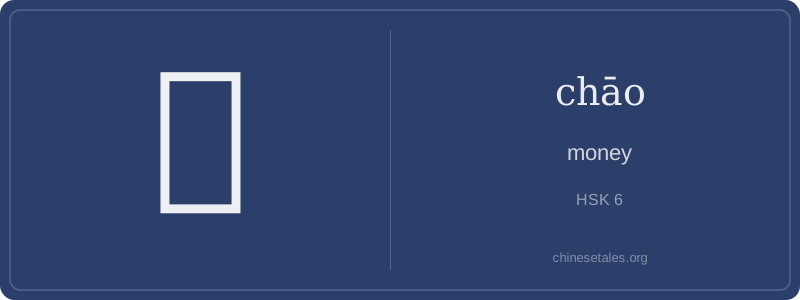
The earliest form of 钞 isn’t ancient at all — it’s a Ming-dynasty (14th c.) innovation, born from the need to name newly issued government paper money. Its left side, 钅 (jīn), is the metal radical — ironic, since 钞 means paper money! But this reflects its conceptual link to currency systems historically backed by metal (silver, copper coins). The right side, 少 (shǎo, 'few, little'), was borrowed phonetically: in Middle Chinese, 少 sounded close to chāo, making it a 'phonetic component'. Over centuries, the character simplified from complex Song-era variants into today’s clean 9-stroke form: 钅 + 少, with the metal radical anchoring it in the financial semantic field.
This visual irony — metal radical + paper-money meaning — mirrors China’s monetary evolution: from bronze coins (铜钱) to silver ingots (银锭) to Ming ‘treasure notes’ (宝钞, bǎo chāo), the world’s first widely circulated state-issued paper currency. The term 宝钞 appears in the 1375 Ming Code, where violating its usage carried harsh penalties — underscoring how seriously paper money was taken. Even today, the shape whispers history: 钅 says 'this belongs to the realm of value and exchange', while 少 hints at scarcity — a quiet nod to inflation fears that haunted early paper currencies across civilizations.
Think of 钞 (chāo) as Chinese slang’s answer to 'greenbacks' or 'dough' — it’s the colloquial, slightly informal word for paper money, carrying the same casual energy as 'cash' does in English. Unlike the formal, all-encompassing 货币 (huòbì, 'currency') or the poetic 金 (jīn, 'gold'), 钞 zeroes in on physical banknotes — the crinkly, ink-smudged bills you hand over at a street-food stall or count nervously before a big purchase. It’s rarely used alone; you’ll almost always see it in compounds like 纸钞 (zhǐ chāo, 'paper currency') or 外汇钞票 (wàihuì chāopiào, 'foreign exchange notes').
Grammatically, 钞 is a noun and never a verb — a common trap! Learners sometimes try *chāo le* ('to cash') by analogy with 换 (huàn), but no: that’s 换钱 (huàn qián). Also, 钞 doesn’t mean 'money' in the abstract sense — you wouldn’t say *我需要钞* ('I need money'); instead, use 钱 (qián) or 资金 (zījīn). It only appears where paper currency is specifically implied: *这张钞是假的* (Zhè zhāng chāo shì jiǎ de) — 'This bill is fake.' Note how it pairs with 张 (zhāng), the measure word for flat, sheet-like things — just like 'a sheet of paper' or 'a dollar bill.'
Culturally, 钞 carries subtle class and generational nuance: older speakers may avoid it as too slangy, while Gen Z uses it freely online (*赚钞* 'make cash', *钞能力* 'cash power' — joking about wealth-based influence). And here’s a sneaky pitfall: because 钞 looks similar to 钞票 (chāopiào), learners sometimes omit the 票 and write *钞* alone — but standalone 钞 feels abrupt, like saying 'bill' without 'dollar' in English. It’s grammatically incomplete outside fixed phrases.