锋
Character Story & Explanation
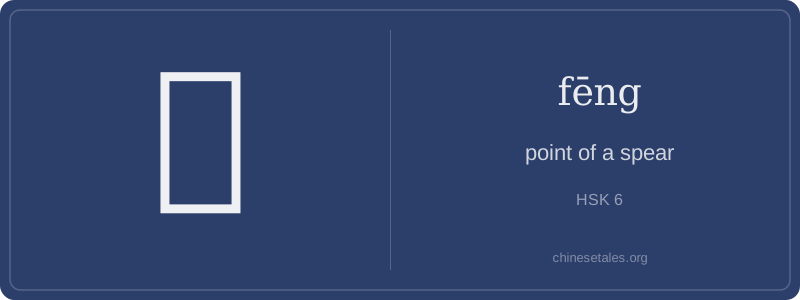
The earliest form of 锋 appears in bronze inscriptions around 1000 BCE — not as a full pictograph of a spear, but as a compound: the radical 钅 (jīn, 'metal') fused with 封 (fēng, 'to seal, to enclose'), which itself originally depicted a ritual mound topped with a tree. Over centuries, the 'seal/mound' component simplified into the phonetic element 封, while the metal radical 钅 stayed front and center — visually anchoring the idea of a *metal object made sharp enough to pierce or define boundaries*. By the Qin dynasty seal script, the 12 strokes had crystallized: four for 钅 (left side), eight for 封 (right side), each stroke deliberately angular, mimicking the rigid geometry of forged blade tips.
This evolution mirrors its semantic journey: from concrete weapon tip (Warring States military texts like *The Art of War* refer to 'spearpoints breaking formation') to abstract force — by the Tang dynasty, poets like Du Fu used 锋 metaphorically: '笔锋所向,无人能挡' ('Where his brush-tip pointed, none could withstand'). The character’s visual rigidity — all straight lines, no curves — reinforces its association with decisive action. Even today, calligraphers emphasize the sharp downward stroke of 封’s final 'foot' (寸) as the 'cutting thrust' — a living echo of its martial origin.
Think of 锋 (fēng) as the Chinese equivalent of the 'cutting edge' — not just literally, but metaphorically, like saying 'the spearpoint of innovation' in English. Its core meaning is the sharp tip of a weapon (especially a spear), but in modern usage, it’s almost never about actual spears. Instead, it’s the go-to character for any kind of sharpness: intellectual acuity (锋利的思维), competitive advantage (抢占先机,抢占锋线), or even stylistic boldness (文风犀利如锋). It carries a dynamic, slightly aggressive energy — you wouldn’t use it to describe gentle wisdom, but rather incisive, unstoppable insight.
Grammatically, 锋 rarely stands alone. It’s almost always bound: either as the second character in compounds like 锋利 (fēng lì, 'sharp') or 先锋 (xiān fēng, 'vanguard'), or embedded in idioms like 出其不意,攻其不备,直取中锋 (a Go/Weiqi strategy term meaning 'strike at the central vital point'). Learners often mistakenly treat it like a standalone noun ('a spearpoint') — but in real speech, you’ll hear 锋 only in tightly packed, high-register phrases. Try saying *bīng rèn de fēng* — technically correct, but native speakers would just say *dāo fēng* (knife edge) or *jiàn fēng* (sword tip).
Culturally, 锋 evokes martial precision and strategic timing — think Sun Tzu’s emphasis on striking where the enemy is unprepared, not where they’re strongest. A common mistake is overusing it in writing to sound 'literary', resulting in awkward, archaic phrasing. Also, beware tone: fēng (first tone) is easily mispronounced as fěng (third tone), which means 'to ridicule' — a hilarious but disastrous slip in formal contexts!