锦
Character Story & Explanation
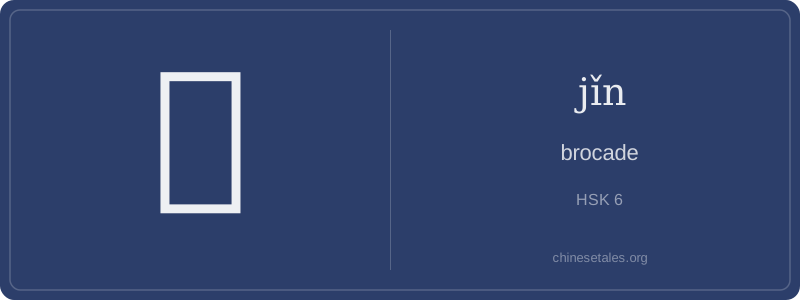
The earliest form of 锦 appears on Warring States bamboo slips as a complex pictograph: top part depicted interlaced warp-and-weft threads (represented by 糸 'silk' radical), bottom part showed a loom or tool — later simplified into 巾 ('cloth') and eventually replaced by 钅 in the Han dynasty. Why the switch to ‘metal’? Because during the Qin and Han dynasties, brocade was so valuable it was stored alongside bronze ritual vessels and taxed like precious metal — scribes began using 钅 to emphasize its economic weight, not its composition. Over centuries, the right side evolved from 巾 to 金 (gold), then stylized into the current 金-like component above 钅 — preserving the idea of golden luster and elite status.
This visual shift mirrors its semantic rise: from a specific high-end textile in the Zhou dynasty (mentioned in the *Book of Songs* as ‘fine-patterned silk’), 锦 became a cultural cipher for beauty and refinement. In Tang poetry, Li Bai wrote of ‘a brocade river reflecting clouds’ — using 锦 not for cloth, but for luminous, layered richness. Even today, when a university awards a ‘Jǐnzhāng’ (brocade banner), it’s not handing out fabric — it’s conferring honor as enduring and radiant as imperial silk.
At its heart, 锦 (jǐn) is not just 'brocade' — it’s luxury made visible: richly woven silk with gold threads, historically reserved for emperors, scholars, and sacred texts. The character pulses with connotations of rarity, artistry, and auspiciousness — so much so that in modern Chinese, it’s often used metaphorically to evoke splendor or excellence (e.g., 锦绣前程 'a brilliant future'). Notice how the left radical 钅 (jīn, 'metal') seems odd for a textile — but this is no typo! It reflects ancient bronze-age metallurgical symbolism: early brocades were so precious they were valued like metal, and the radical here signals *value*, not material.
Grammatically, 锦 functions primarily as a noun ('brocade'), but more frequently appears in compound nouns (锦缎, 锦旗) or as an elegant attributive in literary phrases (锦上添花). Crucially, it almost never stands alone in speech — you won’t hear someone say *‘This is jǐn’* — it’s always embedded: 锦袍 (brocade robe), 锦囊 (embroidered pouch). Learners often mistakenly treat it like a generic fabric term (like 布 bù), but 锦 implies craftsmanship, status, and cultural weight — using it casually risks sounding archaic or ironically pompous.
Culturally, 锦 is steeped in poetic tradition: the idiom 锦绣河山 (jǐn xiù hé shān) — 'brocade-and-embroidery rivers-and-mountains' — doesn’t describe geography literally; it poetically frames China’s landscape as a masterpiece of natural artistry. A common learner pitfall? Confusing 锦 with 棉 (mián, 'cotton') — both refer to fabrics, but 锦 is elite silk; 棉 is humble, everyday fiber. Also, while 锦 sounds like ‘jin’ in English, don’t misread it as ‘jin’ in ‘Jin dynasty’ — that’s 晋 (jìn), a completely different character with a falling tone and political meaning.