镇
Character Story & Explanation
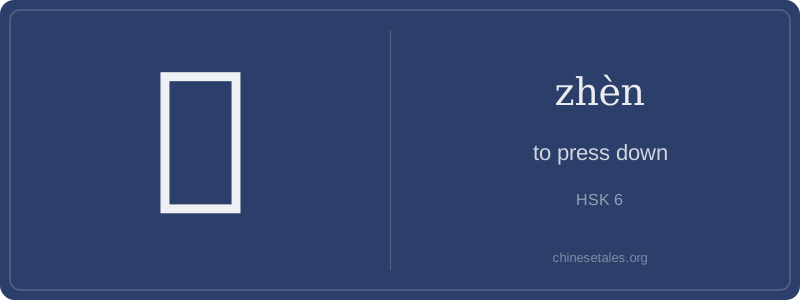
The earliest form of 镇 appears in bronze inscriptions as a combination of 金 (jīn, metal) and 真 (zhēn, true/real), but crucially — with a top component resembling 目 (eye) + 丨 (a vertical line), later stylized into 真. Originally, it depicted a *metal weight* (like a seal or ceremonial anchor) placed deliberately — the ‘true’ or ‘authentic’ act of fixing something in place. Over centuries, the left radical standardized to 钅 (the ‘metal’ radical), while the right evolved from 眞 (archaic form of 真) into today’s 真 — preserving the sense of ‘genuine, unwavering pressure’. The 15 strokes map this logic: 5 for 钅 (metal’s solidity), 10 for 真 (truth + weight).
This visual origin directly shaped its semantic journey. In the *Book of Rites*, 镇 described ritual bronze weights used to secure ceremonial cloths — literal anchoring. By Han dynasty texts, it extended metaphorically to ‘stabilize governance’ (镇国) and ‘quell rebellion’ (镇反). Even in Tang poetry, Du Fu wrote of mountains 镇西南 — not ‘standing in’ the southwest, but *anchoring* the realm’s balance. The character never lost its dual essence: physical mass + moral authority. Its modern use in 镇静 (calmness) or 镇痛 (pain suppression) still echoes that ancient bronze weight — applied not with violence, but precision and legitimacy.
At its heart, 镇 (zhèn) is about *controlled weight* — not brute force, but the calm, deliberate pressure that steadies, silences, or subdues. Think of a heavy stone placed on fluttering papers in a breeze: it doesn’t crush, it *anchors*. That’s the visceral feel — authority grounded in stillness, not shouting. This isn’t just ‘to press down’ like stepping on a bug; it’s to suppress unrest, soothe panic, or stabilize chaos — always with intention and often institutional backing.
Grammatically, 镇 shines as a transitive verb requiring an object (e.g., 镇压反动势力), but its real magic is in compound verbs and abstract usage. You’ll see it in literary phrases like 镇定自若 (zhèn dìng zì ruò — 'calm and composed'), where it’s no longer physical pressing but *inner steadying*. Learners often mistakenly use it for simple physical actions ('press a button' → ❌ 镇按钮; ✅ 按按钮). Also, be careful: 镇 never stands alone as a noun meaning 'town' without context — that’s a homophone (zhèn) from a different character (鎮, simplified to 镇), but the *meaning* 'town' comes from historical military garrisons — which ties back to its core idea of 'imposing order'!
Culturally, 镇 carries quiet gravity. In classical texts like the *Zuo Zhuan*, it describes how wise rulers ‘镇民以德’ (stabilize the people with virtue) — power exercised through moral weight, not coercion. Modern learners trip up by over-translating it as ‘suppress’ (too harsh) or under-translating as ‘calm’ (too soft). The sweet spot? *To impose calm through authoritative presence.* It’s why you’d say 镇住场面 (zhèn zhù chǎng miàn — 'hold the situation steady') at a chaotic meeting — not with volume, but with unshakeable composure.