镶
Character Story & Explanation
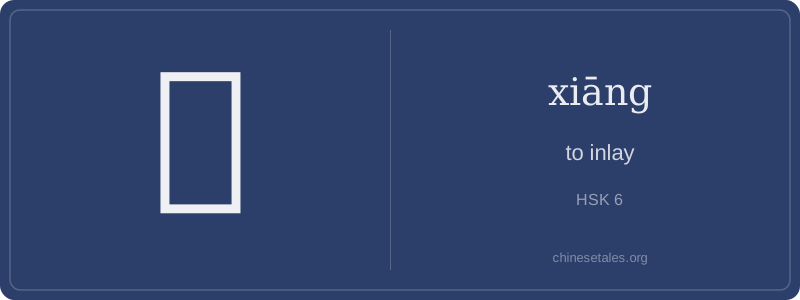
The earliest form of 镶 appears in Warring States bronze inscriptions as a compound: left side showed a metal tool (釒/钅), right side depicted two hands (two 又 radicals) carefully placing a precious stone (represented by 王, the ‘jade’ radical) into a groove — literally ‘inserting jade with metal tools’. Over centuries, the two 又 simplified into 想’s right side (相), and the jade (王) shifted downward, merging with the lower part to form the modern 鑲 (traditional) / 镶 (simplified). The 22 strokes encode this labor: every curve and hook mimics the chisel’s path and the stone’s snug fit.
By the Tang dynasty, 镶 appeared in poetry describing ornate armor — Du Fu wrote of generals whose helmets were ‘金甲银鞍,玉带锦鞍,皆以珠翠镶之’ (gold armor, silver saddles, jade belts, all inlaid with pearls and kingfisher feathers). Its meaning never strayed from intentional, skill-based embedding — unlike 嵌 (qiàn), which can imply forceful insertion. Even today, master artisans in Suzhou still say, ‘镶活儿要‘咬住’——not sit on top,’ meaning the inlay must ‘bite’ into the base, just as the character’s structure bites into your memory.
At its heart, 镶 (xiāng) is about precision craftsmanship — not just sticking something on, but embedding it seamlessly into a surface so it becomes part of the whole. Think gold inlaid in lacquer, jade set into bronze, or mother-of-pearl embedded in wood. It’s a deliberate, skilled act: the object inserted (the ‘inlay’) must match the host material in depth, contour, and harmony — no gluey afterthoughts! This isn’t casual decoration; it’s structural integration.
Grammatically, 镶 is almost always transitive and used with a noun specifying *what* is being inlaid and *into what*. You’ll see patterns like ‘镶 + [material] + 在 + [surface]’ (e.g., 镶金在剑鞘上) or the compact ‘镶 + [material] + [noun]’ (e.g., 镶金剑鞘). Learners often mistakenly use it like 贴 (tiē, ‘to paste’) — but 镶 implies carving a recess first, then fitting. Using it for stickers or tape? That’s a red flag!
Culturally, 镶 evokes imperial workshops, Ming dynasty furniture, and Buddhist ritual objects where materials weren’t just layered — they were married. Modern usage extends metaphorically: 镶嵌式教学 (‘inlaid-style teaching’) describes curriculum design where skills are interwoven, not taught in isolation. A common error? Confusing 镶 with 相 (xiāng, ‘mutual’) due to identical pronunciation — but their meanings and radicals (钅 vs. 木) couldn’t be more different.