阐
Character Story & Explanation
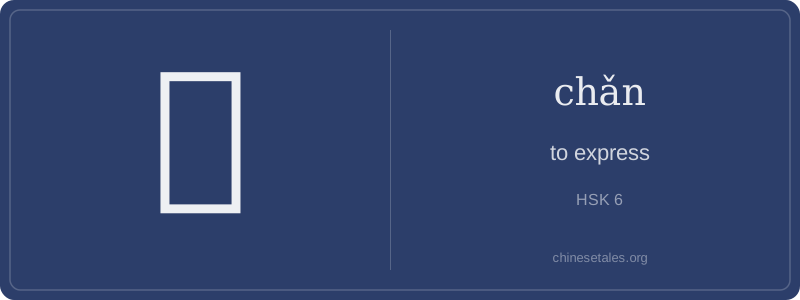
The earliest form of 阐 appears in seal script as a combination of 门 (a stylized gate or doorway) and 单 (dān, originally a ceremonial bronze bell or ritual vessel — later simplified to 卄+十). In oracle bone inscriptions, 单 depicted a bell suspended between two posts, symbolizing resonance and proclamation. Over centuries, the bell evolved into the modern 单 component (now written as 卄 + 十), while the gate remained firmly as the left-side radical — visually encoding the idea of ‘opening the gate to let profound sound/meaning emerge’.
This image of opening a portal to resonant truth became central to classical usage: in the *Zuo Zhuan*, commentators 阐发 (chǎn fā) ancient odes — not merely reciting them, but unlocking their moral resonance. By the Tang dynasty, Buddhist translators used 阐 extensively for ‘expounding sutras’, reinforcing its link to authoritative, layered interpretation. The character’s structure itself invites reflection: the gate (门) is wide open, but what flows through is not noise — it’s the disciplined, single-minded (单) articulation of essence. That duality — openness paired with precision — still defines its modern use.
At its heart, 阐 (chǎn) isn’t just ‘to express’ — it’s to *unfold* meaning with clarity and authority, like rolling out a scroll of profound insight. Think of a scholar opening a heavy lacquered door (the 门 radical!) to reveal carefully arranged wisdom inside: not casual chatter, but deliberate, structured exposition. You’ll rarely hear it in daily chit-chat; instead, it lives in academic papers, philosophical lectures, and official interpretations — always implying depth, intention, and intellectual responsibility.
Grammatically, 阐 is almost always transitive and appears in formal compound verbs: 阐明 (chǎn míng, ‘to clarify’), 阐述 (chǎn shù, ‘to expound’), or 阐释 (chǎn shì, ‘to interpret’). It rarely stands alone — you won’t say *‘I chǎn my opinion’*; you’ll say *‘I chǎnshù my viewpoint’*. A common learner mistake is overusing it like English ‘explain’, leading to unnatural, overly solemn speech — imagine saying ‘Let me chǎn this recipe’ at dinner! Instead, use 解释 (jiěshì) for everyday explaining.
Culturally, 阐 carries the weight of classical scholarship: Confucian commentators didn’t just ‘say’ things — they 阐微 (chǎn wēi, ‘elucidate subtle principles’). Its tone (third tone) adds a sense of measured gravity — like leaning forward slightly when delivering a key insight. Mastering 阐 means understanding not just vocabulary, but the Chinese value placed on *how* truth is revealed: thoughtfully, respectfully, and without haste.