陋
Character Story & Explanation
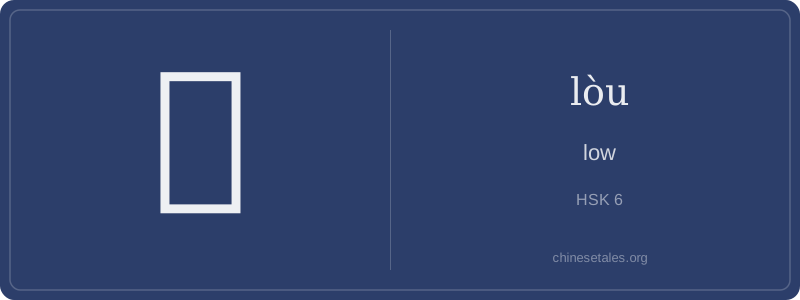
The earliest form of 陋 appears in bronze inscriptions as a combination of 阜 (fù, ‘mound’ or ‘hill’, later simplified to 阝 on the left) and 丙 (bǐng, originally a pictograph of a bright torch or ritual vessel). Over centuries, 丙 evolved into + 冂 + 一, then further stylized into the modern 丆 + 一 + 丨 shape on the right — eight strokes total. The left radical 阝 (fù) hints at location or terrain — suggesting something ‘situated low’ or ‘in an inferior place’ — while the right side subtly evokes dimness or lack of light (think: extinguished torch), reinforcing the idea of backwardness.
By the Warring States period, 陋 had shifted from literal ‘low-lying land’ to figurative ‘unsophisticated, uncultured’. Its most famous appearance is in Liu Yuxi’s Tang dynasty essay *The Modest Cottage* (《陋室铭》), where he defiantly declares his humble abode ‘not shabby’ (何陋之有) — turning 陋 into a rhetorical weapon against superficial judgments. Visually, the character’s compact, slightly cramped structure mirrors its meaning: no open space, no flourish — just functional austerity with a hint of apology.
Don’t be fooled by the English gloss 'low' — 陋 (lòu) is actually a rich, culturally loaded word for *crude, shabby, backward*, or *uncultivated*, carrying quiet moral judgment. It’s rarely used alone; instead, it appears in compound adjectives like 丑陋 (ugly), 简陋 (crude/simple), or 陋习 (bad habit), always implying a deficit — not just of quality, but of refinement, education, or social grace. To Chinese ears, calling something 陋 isn’t neutral description; it’s a subtle cultural sigh — like saying 'this lacks the polish of civilization.'
Grammatically, 陋 functions almost exclusively as a bound morpheme: you’ll never hear someone say *‘This room is lòu’* as a standalone predicate. Instead, it pairs tightly — often with 简 (jiǎn) → 简陋 (jiǎn lòu, ‘spartan and crude’), or with 习 (xí) → 陋习 (lòu xí, ‘deep-rooted bad custom’). Learners who try to use it predicatively (e.g., *‘这个想法很陋’*) sound unnatural — native speakers would say 这个想法很粗浅 or 很不成熟 instead.
Culturally, 陋 reveals Confucian sensibilities about self-cultivation: what’s ‘low’ isn’t just physically humble — it’s morally or intellectually unrefined. In classical texts like the Analects, 孔子 says ‘君子居之,何陋之有?’ (‘If a noble person lives there, how can it be shabby?’) — reframing material simplicity as virtue when paired with virtue. A common learner mistake is overgeneralizing 陋 to mean ‘poor’ or ‘small’; remember: it’s about *cultural inadequacy*, not economic status or size.