陷
Character Story & Explanation
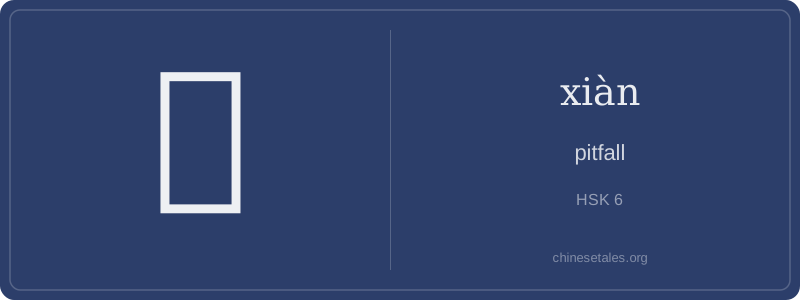
The earliest form of 陷 appears on Warring States bamboo slips as a compound: a left-side pictograph resembling a pit or trench (阜, later simplified to 阝—the ‘mound’ or ‘hill’ radical) paired with a right-side element depicting a person (人) falling headfirst into it—sometimes shown with arms flailing or legs bent sharply downward. Over centuries, the person morphed into the modern 又 (yòu, ‘again’), which here functions purely phonetically and visually as a shorthand for ‘downward motion’—not its usual meaning. The radical 阝 remained anchored on the right, signaling terrain-related danger (unlike most left-side radicals, this one is a ‘right ear’ variant indicating geographical features).
This visual logic held firm across dynasties: in the *Zuo Zhuan*, we read of armies ‘陷于淖’ (sinking into mud), where 陷 captures both physical submersion and strategic entrapment. By the Tang, poets like Du Fu used it metaphorically—‘国破山河在,城春草木深。感时花溅泪,恨别鸟惊心。烽火连三月,家书抵万金。白头搔更短,浑欲不胜簪。’ Though 陷 doesn’t appear here, its semantic shadow looms over lines describing collapse and ruin. Its enduring power lies in how perfectly its shape mirrors its meaning: a figure disappearing into the earth—literally and figuratively swallowed whole.
At its core, 陷 (xiàn) evokes a sudden, dangerous loss of footing—like stepping into an invisible hole in the ground. It’s not just ‘a pit’; it’s the moment of collapse: sinking, being trapped, or falling into deception. The character feels visceral and slightly ominous—think of a soldier sinking into quicksand, a company collapsing under debt, or someone falling prey to flattery. It carries weight, urgency, and often irreversible consequence.
Grammatically, 陷 is almost always a verb, used transitively (it needs an object), and frequently appears in passive or resultative constructions. You’ll see it in patterns like 陷入… (fall into…), 陷于… (be plunged into…), or 陷害 (to frame/slander). Crucially, it’s rarely used alone: you don’t say *‘他陷’ — you say 他陷入了困境 (He fell into difficulty) or 她被陷害了 (She was framed). Learners often mistakenly treat it as a noun (‘a trap’) or use it intransitively—both break natural usage.
Culturally, 陷 appears everywhere from military strategy texts (e.g., Sun Tzu’s warning about ‘being lured into ambushes’) to modern headlines about financial fraud (资金链断裂,公司陷入破产境地). Its emotional resonance is deep: it implies helplessness, vulnerability, and systemic failure—not just physical danger. A common mistake? Confusing it with 献 (xiàn, ‘to offer’) or 谄 (chǎn, ‘to flatter’)—homophones that share no semantic ground but trip up ears and eyes alike.