隙
Character Story & Explanation
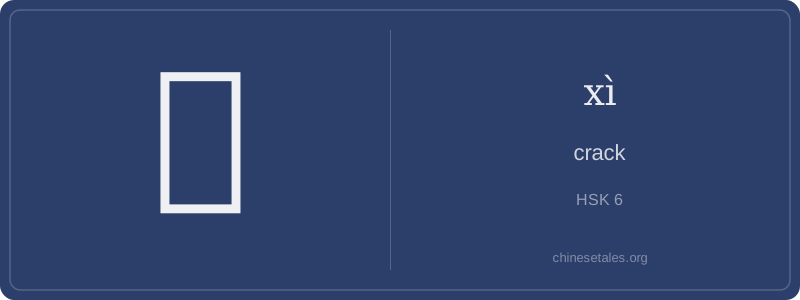
The earliest form of 隙 appears in bronze inscriptions as a compound pictograph: left side showed a wall or barrier (the precursor to 阝, originally 墻 ‘wall’), and right side depicted two interlocking teeth or jagged edges (the origin of 小 + 口 + 日-like elements), visually suggesting *uneven separation*. Over centuries, the wall radical simplified into the modern right-side 阝 (阜, meaning ‘mound’ or ‘terrain feature’), while the right-hand component condensed into the current 小 (small) atop 日 (sun/day) — though this is now purely phonetic, not semantic.
By the Warring States period, 隙 had shifted from literal cracks in masonry to abstract intervals — ‘gaps in time’ (《庄子》 mentions ‘time’s fissures’), and by the Tang dynasty, poets like Du Fu used it emotionally: ‘a crack in the heart’ (心隙) implied suppressed sorrow. Its visual structure — wall + small sun — subtly echoes its meaning: even the smallest light (or truth) finds its way through the narrowest barrier. That duality — structural flaw and portal — remains central today.
At its core, 隙 (xì) isn’t just a physical ‘crack’ — it’s the Chinese eye for *interstitial reality*: the thin, often invisible space *between* things — walls, moments, people, or even intentions. It carries a quiet tension: not destruction, but potential. A crack in a wall hints at decay; a crack in an alibi reveals truth; a crack in time (时光之隙) evokes fleeting, precious opportunity. Native speakers feel its nuance — it’s never neutral, always charged with implication.
Grammatically, 隙 is almost always bound: it rarely stands alone. You’ll find it in compounds like 空隙 (kōng xì, 'gap'), 间隙 (jiàn xì, 'interval'), or 缝隙 (fèng xì, 'crevice'). Crucially, it’s *not* used for metaphorical 'cracks' in character (that’s 缺陷 quēxiàn) or digital 'security holes' (that’s 漏洞 lòudòng). Learners mistakenly say *‘xì kǒu’* (‘crack mouth’) — but that’s nonsensical; instead, it’s always paired: e.g., *yī dào xì* (a crack), *liǎng gè rén zhī jiān de xì* (the gap between two people).
Culturally, 隙 reflects the Daoist and strategic appreciation of ‘the unoccupied space’ — Sun Tzu wrote about exploiting gaps in enemy formation, and classical poets used 隙 to capture the fragile sliver of light piercing bamboo groves or the brief pause before a storm breaks. Mistake it for mere ‘hole’, and you miss its poetic weight: it’s where meaning leaks in — and out.