雇
Character Story & Explanation
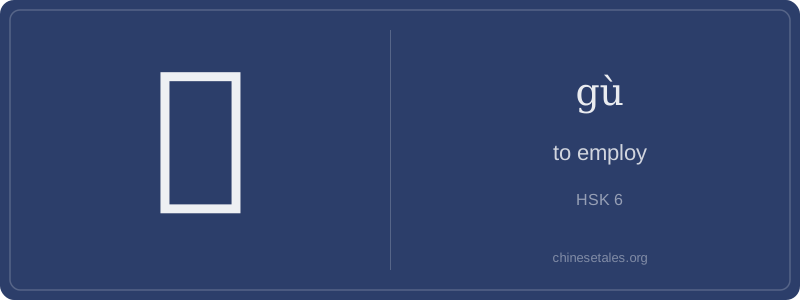
The earliest form of 雇 appears in Warring States bamboo slips as a compound pictograph: on the left, a simplified 'bird' (隹) representing alertness and discernment; on the right, a variant of 俞 (yú), itself combining 'boat' (舟) and 'mouth' (口) — suggesting verbal agreement made during river transport. Over time, 俞 evolved into 12 strokes: the top-left 隹 (8 strokes) retained its avian shape, while the right side morphed from 俞 into the modern 4-stroke component (remembered as 'mouth + boat + axe' but now stylized as 4 lines). By the Han dynasty, clerical script standardized this balance: light, quick strokes for 隹 (the hirer’s sharp eye), heavier strokes for the right side (the weight of commitment).
Meaning shifted organically: from 'to hire a boatman via oral pact' (Zuo Zhuan, 5th c. BCE) to 'to engage any skilled laborer by contract'. In Tang poetry, Du Fu used 雇 in '雇船载药归' — 'hired a boat to carry herbs home' — showing its enduring link to practical, negotiated service. The character never absorbed bureaucratic abstraction; even today, 雇 feels tactile — you imagine handing over coins, checking credentials, nodding once. Its visual duality — feather-light radical paired with grounded right side — mirrors the act itself: swift decision followed by solemn obligation.
Think of 雇 (gù) as China’s ancient 'hire button' — not a digital tap, but a ritual handshake sealed with grain. Unlike English 'employ', which feels bureaucratic and abstract, 雇 carries visceral weight: it implies *active selection*, often for labor that requires trust and negotiation — like hiring a boatman to cross the Yangtze or a scribe to draft a contract. It’s never passive ('be employed') — you always 雇 someone; the subject is always the hirer. You say 他雇了三个工人 (tā gù le sān gè gōngrén), never *gù le* without an agent.
Grammatically, 雇 is strictly transitive and almost never used in the passive voice (no *bèi gù*). Learners often mistakenly use it like 'to work for' — but 雇 never means 'to be employed'; that’s 受雇 (shòu gù) or 就职 (jiùzhí). Also, it rarely appears in formal HR documents; those prefer 聘 (pìn) for professionals or 招聘 (zhāopìn) for recruitment campaigns. 雇 shines in real-world, hands-on contexts: hiring movers, drivers, tutors, or seasonal farmhands.
Culturally, 雇 evokes pre-modern labor markets — think Ming dynasty merchant guilds negotiating wages in Suzhou’s canals. Its radical 隹 (zhuī, 'short-tailed bird') may seem odd until you learn its secret: in ancient times, 'bird' radicals often signaled *agility, precision, and transactional clarity* — like a hawk swooping to claim its prey. So 雇 subtly suggests the hirer ‘seizing’ the right person, decisively. Mistake it for 菊 (jú, chrysanthemum) or 固 (gù, 'solid'), and your sentence won’t just sound wrong — it’ll smell like tea leaves or concrete.