霞
Character Story & Explanation
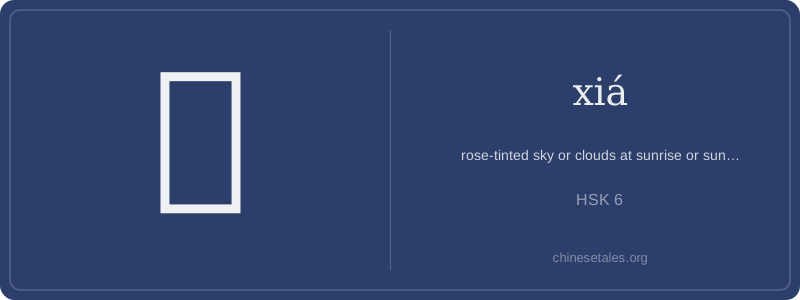
The earliest form of 霞 appears in bronze inscriptions around 800 BCE as a compound pictograph: top half was 雨 (yǔ, ‘rain’ — three horizontal lines + drops), and bottom was 夹 (jiā, ‘to enclose’ or ‘flank’, later simplified to 隹). Over centuries, 夹 evolved into 隹 (zhuī, ‘short-tailed bird’), but its original function wasn’t ornithological — it represented *light rays spreading outward*, like wings embracing the horizon. By the Han dynasty, the character stabilized into its modern 17-stroke form: 雨 (8 strokes) above, and 隹 (9 strokes) below — a perfect visual metaphor: rain-clouds *framing* radiant light.
This evolution mirrors its semantic journey: from early texts like the *Shijing* (Book of Odes), where 霞 described ‘the colored vapor rising from rivers at dawn’, it gradually became synonymous with celestial color itself — not moisture, but luminosity suspended in atmosphere. In Du Fu’s poem ‘Ascending the Yueyang Tower’, he writes ‘落霞与孤鹜齐飞’ (luò xiá yǔ gū wù qí fēi — ‘falling rosy light and a lone wild duck fly together’), cementing 霞 as a literary anchor for harmony between nature and human emotion — a sky-painting done in light, not ink.
Think of 霞 (xiá) as Chinese poetry’s version of a watercolor wash — not a solid object, but a luminous atmospheric event: the soft, rose-gold glow bleeding across the sky just after sunset or before sunrise. Unlike English ‘sunset’ (a noun for an event) or ‘clouds’ (a physical thing), 霞 is inherently *ethereal* and *chromatic*: it names the light itself — tinted, transient, and emotionally charged. You’ll rarely see it alone; it almost always appears in compounds like 晚霞 (wǎn xiá, ‘evening glow’) or 朝霞 (zhāo xiá, ‘morning glow’), functioning as a poetic noun that evokes mood, not meteorology.
Grammatically, 霞 behaves like a countable noun in formal/literary contexts (e.g., 一片霞 — ‘a patch of rosy light’), but never as a verb or adjective. Learners sometimes wrongly treat it like 彩 (cǎi, ‘color’) and say *xiá sè* (‘rosy color’) — but that phrase doesn’t exist; instead, you’d say 霞光 (xiá guāng, ‘rosy light’) or 霞彩 (xiá cǎi, ‘rosy radiance’ — note the *order* matters!). Also, avoid using it casually: saying ‘I saw some xiá’ sounds like quoting Li Bai at brunch — charming, but oddly elevated for small talk.
Culturally, 霞 carries classical elegance — it appears over 40 times in the Tang poetry canon, often symbolizing fleeting beauty or quiet transcendence. A common mistake? Confusing it with 霜 (shuāng, ‘frost’) because both have 雨 on top — but frost is cold, white, and ground-level; 霞 is warm, pink-orange, and sky-high. The radical 雨 here isn’t about rain — it signals *atmospheric phenomena*, linking 霞 to clouds, mist, and dew, not precipitation.