巩
Character Story & Explanation
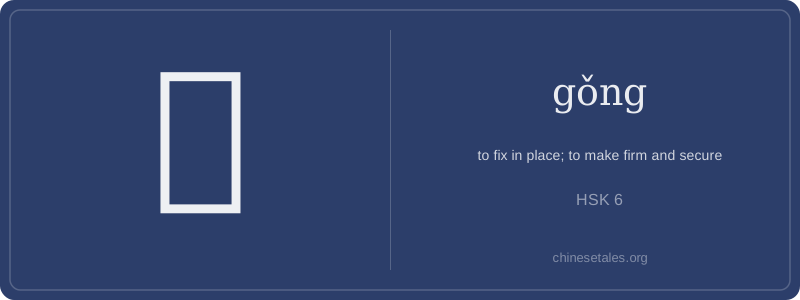
The earliest form of 巩 appears on Warring States bamboo slips — not as a pictograph, but as a phonosemantic compound evolving from two ancient elements: the left side 工 (gōng, 'work, craft') and the right side 凡 (fán, later stylized into 夅 + 一). Originally, 凡 represented a *container with a lid firmly pressed down*, symbolizing containment and control. Over centuries, the right component simplified and merged: the top stroke became a horizontal line, the inner shape condensed into 冂 (a 'hollow enclosure'), and the bottom dot solidified — yielding today’s six-stroke 巩. Every stroke feels intentional: the strong 工 radical anchors the character visually and semantically, while the enclosing shape suggests containment and compression.
This visual logic shaped its meaning. In the Zuo Zhuan (c. 4th century BCE), 巩 appears in descriptions of fortifying city walls — not just building them, but *reinforcing existing structures against siege*. By the Han dynasty, it expanded metaphorically: scholars used 巩 to describe 'strengthening virtue' (巩德) or 'securing ritual propriety' (巩礼). The character never meant 'to build from scratch'; its essence has always been *making what exists unshakable*. That’s why modern Chinese pairs it so naturally with words like 固 (gù, 'firm') — because 巩 doesn’t create strength; it *locks it in place*.
Think of 巩 (gǒng) as the Chinese verb for 'structural reinforcement' — not just 'to fix,' but to *anchor*, *brace*, or *fortify* something that’s already in place. It carries a sense of deliberate, skilled strengthening: imagine a master carpenter adding a diagonal brace to a wobbling beam, or an engineer reinforcing a bridge’s foundation. Unlike generic verbs like fāng (放, 'to put') or ān (安, 'to install'), 巩 implies *enhancing stability under pressure*. You’ll rarely see it alone — it almost always appears in compound verbs like 巩固 (gǒng gù, 'to consolidate') or in formal, written contexts: policy documents, academic papers, or speeches about national resilience.
Grammatically, 巩 is nearly always the first syllable in a disyllabic verb and takes a direct object — never used intransitively ('The wall 巩' is impossible). Learners often mistakenly use it where they mean 'to fix' in the everyday sense (e.g., fixing a leaky faucet), but that’s xiū (修) or zhěng (整). 巩 only applies to abstract or systemic strengthening: 'consolidate achievements,' 'reinforce unity,' 'shore up confidence.' Its tone (third tone) also trips people up — saying 'gōng' (first tone) accidentally makes it sound like the word for 'tribute' or 'palace' (宫), which changes meaning entirely.
Culturally, 巩 evokes Confucian ideals of enduring order — think of the Great Wall not just as a barrier, but as a symbol of *deliberately fortified civilization*. Modern usage leans heavily into political and economic discourse: leaders 'consolidate reforms,' banks 'strengthen risk controls,' schools 'reinforce ideological education.' A classic learner mistake? Using 巩 where 拓 (tuò, 'to expand') or 加强 (jiā qiáng, 'to strengthen' — more general) would be more natural. Remember: 巩 = *bracing the foundation*, not widening the roof.