韧
Character Story & Explanation
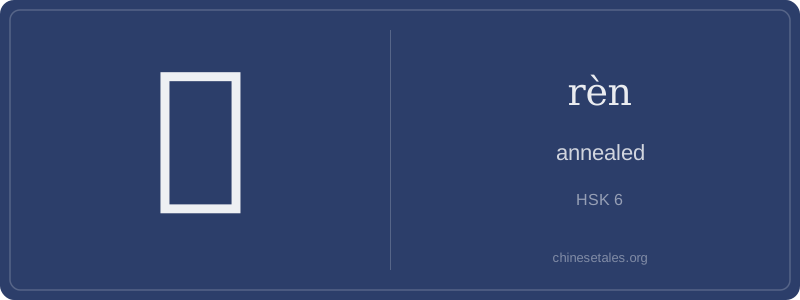
The earliest form of 韧 appears in bronze inscriptions as a combination of 韦 (wéi, 'tanned leather') on the left and 刃 (rèn, 'blade edge') on the right — not as a weapon, but as a symbol of *controlled cutting*. Leather was the ancient Chinese material par excellence for resilience: stretched, scraped, and treated to be both pliable and tough. Over centuries, the blade component evolved into the modern 刂 (knife radical), while 韦 simplified from its original pictograph of leather strips drying on a frame — a visual echo of tension and transformation through process.
This origin directly shaped its meaning: 韧 wasn’t just 'tough' — it was 'tough *because* it had been processed'. By the Warring States period, texts like the *Zhuangzi* praised the '韌之德' — the virtue of yielding like water yet returning to shape like cured hide. Later, in Ming-Qing medical texts, 韧 described tendons’ ability to stretch and recoil — reinforcing its core idea of *elastic endurance*. The character’s very structure — leather (韦) + precision edge (刂) — reminds us that true resilience isn’t accidental; it’s forged through deliberate, skillful refinement.
Think of 韧 (rèn) as Chinese metallurgy’s answer to 'tempered steel' — not brittle like glass, not floppy like wet noodle, but resiliently springy, like a high-tensile guitar string or the sole of a hiking boot that bends without breaking. In English, 'annealed' is technically precise (a heat-treatment process that increases ductility), but in everyday Chinese, 韧 carries far richer connotations: it’s the quiet strength of a bamboo stalk swaying in typhoon winds, the emotional endurance of a parent caring for an aging relative, or the intellectual stamina needed to master classical poetry. It’s never about raw power — it’s about sustained, flexible resistance.
Grammatically, 韧 is almost always used as a noun or adjective in compound words (e.g., 韧性 rènxìng 'resilience'), rarely standalone. You’ll seldom see it as a verb or predicate adjective — don’t say *'他很韧' — instead, say '他有很强的韧性' or '他的性格很有韧性'. Learners often mistakenly use it like 坚强 (jiānqiáng, 'strong-willed') — but 韧 implies elasticity under pressure, while 坚强 suggests unyielding rigidity. A rigid wall cracks; a 韧 material absorbs and rebounds.
Culturally, 韧 is deeply tied to Daoist and Confucian ideals of enduring through adversity without breaking — think of the proverb '柔能克刚' ('softness overcomes hardness'). Westerners sometimes misread it as passive; in truth, it’s active, intelligent persistence. Also beware: 韧 is *not* used for physical toughness in food (that’s 筋道 jīndao) or for mechanical hardness (that’s 硬 yìng). Its domain is functional flexibility — whether in materials, psychology, or social strategy.