顽
Character Story & Explanation
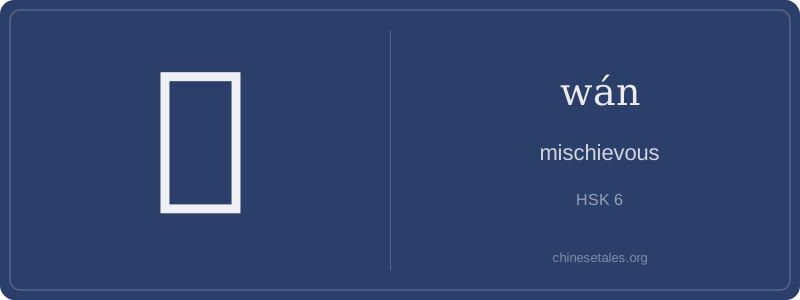
The earliest form of 顽 appears in bronze inscriptions as a compound: the left side was 元 (yuán), depicting a person’s head with emphasis on the top — symbolizing ‘origin’ or ‘first’, but also evoking ‘stubbornness’ (the head won’t turn!). The right side was 页 (yè), the ‘page’ radical, which originally showed a human head with hair and neck — a pictograph of ‘face’ or ‘person’. Over centuries, 元 simplified into the current 丸 (wán), losing its dot and gaining roundness — visually echoing both a small ball (playful, rolling away from control) and the sound wán. Meanwhile, 页 retained its structural role, anchoring the character in the domain of the person — specifically, their demeanor and expression.
This visual evolution mirrors semantic deepening: from early texts like the Shuō Wén Jiě Zì (121 CE), 顽 was defined as ‘unyielding, unteachable’ — a neutral descriptor of rigidity. But by the Tang and Song dynasties, poets like Bai Juyi used 顽 in affectionate contexts (e.g., 顽夫 wán fū — ‘playful fellow’), softening its edge. The roundness of 丸 subtly invited warmth; the head-radical 页 kept it grounded in human personality. So 顽 didn’t just mean ‘obstinate’ — it came to signify *willful charm*: the stubbornness you smile at, not scold.
At its heart, 顽 (wán) isn’t just ‘mischievous’ — it’s the warm, slightly exasperated affection Chinese speakers feel toward someone who’s delightfully stubborn, playfully defiant, or charmingly uncooperative. Think of a toddler refusing naptime with theatrical flair, or a grandfather teasing his grandkids while secretly loving every second — this is 顽: endearing resistance, not malicious troublemaking. It carries emotional texture: often used with gentle irony or fondness, rarely with true disapproval.
Grammatically, 顽 functions mainly as an adjective before nouns (e.g., 顽童 wán tóng ‘mischievous child’) or in fixed compounds; it doesn’t take aspect markers like 了 or 过, nor does it serve as a verb on its own. Learners sometimes mistakenly try to say *‘wán le’* (as if ‘became mischievous’), but that’s unnatural — instead, you’d use verbs like 淘气 (táoqì) for dynamic action. Also, 顽 never stands alone in speech — you won’t hear ‘He is 顽’; it’s always contextualized, like 顽皮 or 顽固.
Culturally, 顽 reflects a nuanced tolerance for spirited individuality — especially in children — as long as it’s rooted in innocence and warmth. Confucian ideals value obedience, yet 顽 survives precisely because it implies *non-harmful*, even virtuous, nonconformity: the kind that sparks creativity or reveals sincerity. A common mistake? Using 顽 where English says ‘naughty’ — but in Chinese, ‘naughty’ (as in morally wrong) is more likely 恶作剧 (è zuò jù) or 不听话 (bù tīng huà). 顽 is never sinister — it’s the twinkle in the eye, not the scowl.