额
Character Story & Explanation
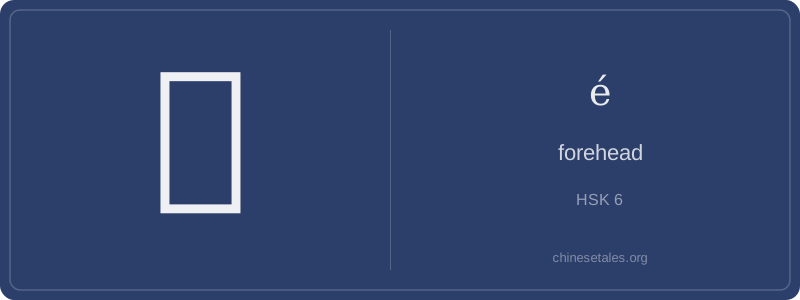
The earliest form of 额 appears in bronze inscriptions (c. 1000 BCE) as a pictograph combining two elements: the top part resembled a stylized human head with a prominent horizontal line across the upper face (the 'forehead'), while the bottom was 页 (yè), originally a picture of a person kneeling with exaggerated head and eyes — later generalized as 'page' or 'head-related'. Over centuries, the top evolved into 各 (gè, 'each'), not for meaning but phonetic borrowing (a common sound-change pattern), while 页 remained the semantic anchor, reinforcing its link to the head and facial features.
This character didn’t appear in early oracle bones, emerging only in Western Zhou bronzes — likely because forehead-specific terminology gained importance with ritual grooming and divination practices (where facial pallor or sweat on the 额 signaled divine response). By the Han dynasty, 额 was standard in medical texts like the Huangdi Neijing, describing pulse locations 'above the eyebrows'. Its visual structure — 各 atop 页 — subtly echoes the idea of 'the unique, defining surface of the head': 各 implies individuality, 页 grounds it in the body. Even today, when writers describe someone's 'broad 额', they’re not just measuring centimeters — they’re invoking intelligence and nobility, a Confucian ideal tied to cranial proportion.
Imagine you're at a traditional Chinese opera rehearsal: the lead actor wipes sweat from his é — not just any forehead, but the very center of his face, where vermilion makeup glows under stage lights. That’s 额 — it doesn’t mean 'face' or 'head' generically; it’s specifically the smooth, hairline-to-eyebrows plane, the anatomical 'forehead'. It carries quiet dignity: in classical texts, a calm 额 signals composure; a flushed 额 hints at shame or exertion. You’ll rarely see it alone — it almost always appears in compounds (like 额头) or in literary/medical contexts.
Grammatically, 额 is a noun that resists bare usage — you won’t say *'I touched é'*; you’ll say *'I touched my forehead (额头)'*. In modern spoken Mandarin, people often default to 头 (tóu) or 额头 (étóu); 额 by itself feels poetic or technical (e.g., medical charts: '额部皮疹' — 'rash on the forehead'). Learners sometimes overuse it like English 'forehead', missing how Chinese prefers compound nouns — a classic HSK 6 trap!
Culturally, 额 appears in idioms with subtle weight: 额手称庆 (‘touch forehead to celebrate’) evokes ancient officials bowing in relief — the gesture conveys profound gratitude, not casual joy. Also watch tone: é is second tone, not fourth (è) — mispronouncing it as 'è' risks confusion with 'to blame' or 'to punish', which sounds completely off-topic when discussing anatomy!