颤
Character Story & Explanation
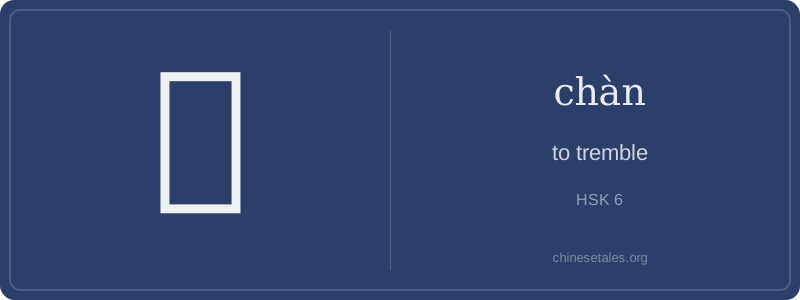
The earliest forms of 颤 appear in late Warring States bamboo texts, not oracle bones — and its structure tells a vivid story. The left side, 奄, originally depicted a person crouching under a roof (a sheltered, vulnerable posture), later stylized into a phonetic component hinting at the ‘an’/‘chan’ sound. The right side, 页 (yè), meaning ‘leaf’ or ‘page’, was actually borrowed for its shape — early scribes used 页 to suggest the fluttering, thin motion of something light and trembling, like a leaf in wind or a page turning rapidly. Over centuries, the strokes fused: the top of 奄 became the inverted ‘v’ (厂), the middle condensed into two horizontal strokes and a dot, and 页 retained its distinctive ‘head-like’ frame — resulting in today’s elegant, slightly top-heavy 19-stroke form.
This visual logic deepened its meaning: by Han dynasty texts, 颤 appeared in medical classics like the Huangdi Neijing to describe pathological tremors (e.g., ‘liver wind causing hand tremors’), linking physical instability to internal imbalance — a core TCM concept. Later, poets like Du Fu used 颤 in lines like ‘秋风扫落叶,枝颤寒鸦惊’ (Autumn wind sweeps fallen leaves; branches tremble, startling cold crows), where the trembling branch isn’t just movement — it’s tension, fragility, and seasonal impermanence made kinetic. The character’s 19 strokes even echo this idea: complex, delicate, and demanding precision — much like the tremor itself.
At its core, 颤 (chàn) isn’t just ‘to tremble’ — it’s the visceral, involuntary shiver of emotion or physiology: a voice quavering with grief, knees knocking before a speech, or leaves shivering in a sudden wind. Unlike generic synonyms like 抖 (dǒu), which implies mechanical or rhythmic shaking (e.g., shaking salt), 颤 carries emotional weight and physiological immediacy — it’s what happens when your body betrays your composure. You’ll often see it in literary or formal registers, especially describing vocal cords (声音颤抖), limbs (双手颤抖), or even abstract things like 'a trembling hope' (颤抖的希望).
Grammatically, 颤 is almost always used as a verb, typically in compound form (e.g., 颤抖, 颤动) or as a stative verb with aspect particles: 他说话时声音一直在颤抖 (His voice kept trembling while he spoke). Crucially, it’s rarely used alone — learners who write *他颤* sound unnatural; native speakers say *他颤抖着* or *他手在颤*. Also, note its tonal sensitivity: chàn (4th tone) is standard; chān (1st tone) is archaic or dialectal and best avoided.
Culturally, 颤 reveals how Chinese language encodes embodied emotion — not as metaphor, but as somatic fact. In classical poetry, trembling hands signal moral awe (e.g., holding a revered scroll); in modern media, a trembling lip signals suppressed tears far more powerfully than ‘crying’. A common mistake? Overusing it for mild shakiness (e.g., a wobbly table → 抖, not 颤). Reserve 颤 for moments where the tremor carries psychological resonance — when the body speaks louder than words.