饶
Character Story & Explanation
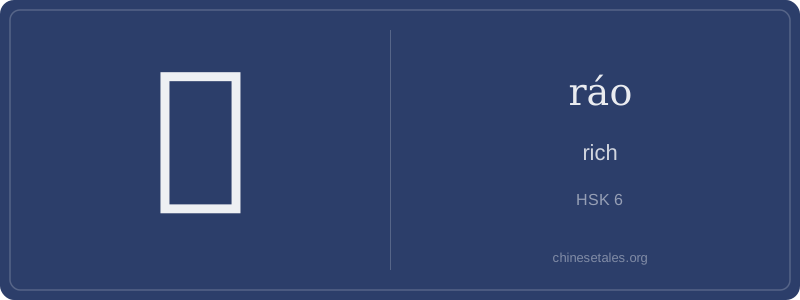
The earliest form of 饶 appears in seal script, where its left side was the full 食 (shí, 'to eat')—not just the abbreviated 饣 radical we see today—and the right side was 尧 (yáo), both a phonetic clue and a meaning carrier: 尧 was the legendary sage-king known for benevolent, abundant rule. Over centuries, 食 simplified to 饣 (food radical), while 尧 retained its shape—9 strokes total: 3 for 饣 + 6 for 尧. Visually, it’s a delicious paradox: a food radical paired with a symbol of virtuous sovereignty—suggesting nourishment flows from wise, generous leadership.
This visual logic shaped its meaning evolution. In the *Zuo Zhuan* (c. 4th c. BCE), 饶 described fertile lands 'rich enough to sustain many'; by the Tang dynasty, it extended to personal qualities—like Du Fu praising a friend’s poetry as 饶有风致 ('abundant in charm and style'). The character never lost its dual grounding: physical plenitude (land, food, resources) and moral amplitude (forgiveness, tolerance, eloquence). Even today, 饶恕 doesn’t mean 'grudgingly pardon'—it implies the forgiver is so rich in virtue they don’t need retribution.
At its heart, 饶 (ráo) isn’t just about material wealth—it’s about *abundance with grace*: surplus that spills over generously, resources that allow for leniency or indulgence. Think less 'bank balance' and more 'a banquet table so laden you can afford to let someone off the hook.' In classical and literary Chinese, it often appears in phrases like 饶恕 (ráoshù, 'to forgive')—where 'richness' morphs into moral spaciousness: only the spiritually abundant can spare others. This semantic leap reveals a deep Chinese cultural link between material sufficiency and ethical capacity.
Grammatically, 饶 shines in compound verbs and adjectives—not as a standalone adjective like 富 (fù, 'rich'). You won’t say *‘他很饶’* (❌); instead, it pairs tightly: 饶有 (ráo yǒu, 'abundantly possesses'), 饶舌 (ráo shé, 'talkative—literally “rich-tongued”'), or the elegant 饶有趣味 (ráo yǒu qùwèi, 'full of interest'). Learners often mistakenly treat it like an adjective; remember: it’s a *relational* character—it needs context to bloom.
Culturally, 饶 carries quiet prestige: it appears in surnames (Ráo), place names (Ráozhōu), and poetic registers, signaling refinement rather than flash. A common pitfall? Confusing it with 娆 (ráo, same pinyin!)—which means 'charming' and has 女 (female) radical, not food. Mixing them turns 'generous land' into 'alluring woman.' Also, note its tone: second tone (ráo), never third—mispronouncing it as rǎo sounds like 'to disturb,' a jarring semantic whiplash!