晚
Character Story & Explanation
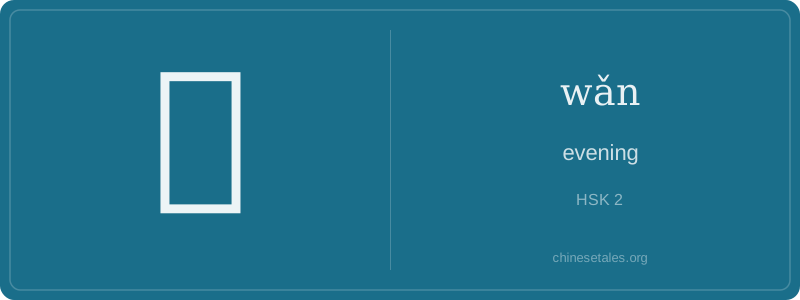
The earliest form of 晚 appears in bronze inscriptions around 800 BCE: a stylized sun (日) above a simplified figure with bent knees and raised arms — not a person, but the ancient glyph 免, depicting someone *avoiding* or *withdrawing* (think of ducking under a low beam). Over centuries, the kneeling figure evolved into the modern 免 — losing its legs, gaining a hat-like top (⺈), and settling into its current shape beside 日. By the Han dynasty, the two components fused cleanly: the sun dipping *away*, no longer visible — the visual logic couldn’t be clearer.
This pictorial logic held steady through classical texts: in the Shī Jīng (Book of Odes), 晚 describes 'the sun’s late course' over western hills, evoking melancholy beauty. By Tang poetry, it became inseparable from human ritual — 'returning home at dusk' (暮归 mù guī) signaled safety, family, and the day’s sacred closing. Even today, the character’s structure mirrors this ancient truth: the sun (日) doesn’t vanish — it simply *steps back* (免), making room for rest, reflection, and quiet connection.
At its heart, 晚 (wǎn) is about time’s gentle descent — not just 'evening' as a clock hour, but the soft, liminal space between day and night: twilight, dusk, or even 'late' in a broader sense. Its radical 日 (rì, 'sun') anchors it firmly in solar time, while the right-hand component 免 (miǎn, originally meaning 'to avoid' or 'to exempt') hints at the sun’s *withdrawal* — as if the sun is stepping aside, bowing out gracefully. This isn’t a sudden cutoff like 黑 (hēi, 'black') for nightfall; it’s a quiet, respectful retreat.
Grammatically, 晚 is wonderfully flexible. As a noun, it pairs naturally with time markers: 今天晚上 (jīn tiān wǎn shàng, 'tonight') or 每晚 (měi wǎn, 'every evening'). As an adjective, it means 'late' — but only when referring to time (e.g., 晚到 wǎn dào, 'arrive late'), never for lateness in abstract senses like 'delayed project' (that’s 迟 chī). Learners often mistakenly use 晚 for 'late' in contexts like 'a late payment' — a classic HSK 2 trap that triggers native speakers’ eyebrows!
Culturally, 晚 carries warmth and intimacy: 晚安 (wǎn ān, 'good night') isn’t just a farewell — it’s a blessing, implying care and safety through the dark hours. And note: while 晚 always implies *temporal* lateness, it never means 'old' (that’s 老 lǎo) or 'backward' (that’s 后 hòu). Its charm lies in its calm authority — the sun has set, yes, but the world hasn’t ended; tea is still warm, stories are still told.