腾
Character Story & Explanation
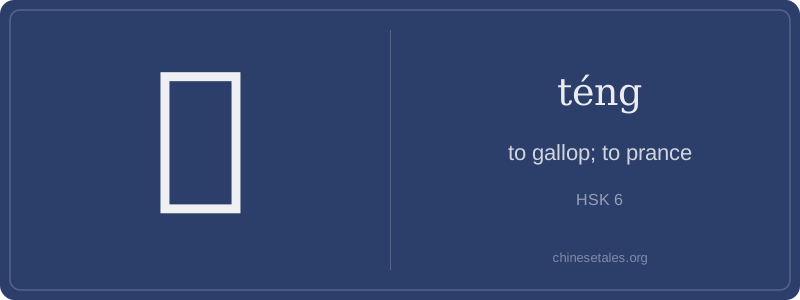
The earliest form of 腾 appears in bronze inscriptions as a complex pictograph: a kneeling figure (the precursor to today’s 月/⺼ radical, representing the body) beneath a stylized 'dragon' or 'serpent' head with horns and swirling lines — symbolizing a creature coiling upward with explosive force. Over centuries, the upper part simplified into 朕 (zhèn, originally 'I' — but here purely phonetic), while the lower part evolved from 肉 (ròu, 'flesh') into the modern ⺼ radical. By the seal script era, the structure stabilized: 朕 above (sound), ⺼ below (meaning domain: bodily energy/motion).
This visual fusion — phonetic 朕 + semantic ⺼ — tells the story: it’s not just any movement, but *body-powered ascension*. In the Classic of Poetry (Shījīng), 腾 described horses leaping over ditches; by the Han dynasty, it was used for dragons ascending clouds in Daoist texts. The character’s enduring magic lies in how its shape literally layers sound and meaning: the 'I' (朕) whispers authority and presence, while the flesh radical roots that power in the human — or mythical — form. You don’t just move with 腾; you *launch yourself into significance*.
Think of 腾 (téng) as Chinese mythology’s version of Pegasus mid-leap — not just moving, but *defying gravity with elegance and power*. Its core meaning isn’t merely 'to gallop' like a horse on flat ground; it’s about upward, dynamic propulsion: a dragon coiling skyward, steam rising from boiling water, or ambition surging beyond limits. It evokes lightness-in-motion, almost balletic intensity — closer to 'to soar with momentum' than plain 'to run'.
Grammatically, 腾 is rarely used alone in modern Mandarin. It’s the engine inside compound verbs and set phrases: 腾空 (téng kōng, 'to soar into the air'), 腾飞 (téng fēi, 'to take off rapidly — often for economies or careers'), or the reflexive 腾出来 (téng chū lái, 'to free up space/time'). Learners often mistakenly use it transitively like 'I腾 the room' — but it doesn’t take a direct object that way; instead, you say 我腾出一间房 (I freed up a room). The verb needs a complement like 出来, 开, or 起来 to complete its action.
Culturally, 腾 carries auspicious, energetic connotations — dragons '腾云驾雾' (ride clouds and mist), startups '腾飞', even stock markets '腾涨'. But beware: using it solo as a main verb ('He ténɡed') sounds archaic or poetic, not conversational. And while it shares the ⺼ (flesh/body) radical — hinting at physical vitality — it’s *not* about the body per se, but about the *body’s motion becoming metaphor for ascent and transformation*.