鸣
Character Story & Explanation
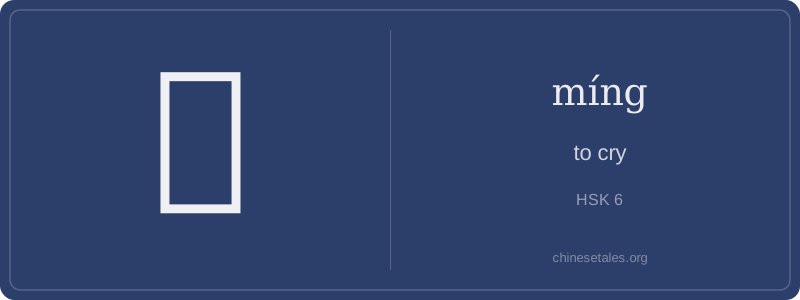
The earliest form of 鸣 appears in oracle bone inscriptions as a combination of 口 (mouth/sound) and 鸟 (bird), often drawn with a stylized head and wings beside an open mouth — literally ‘bird-sound’. Over time, the bird radical simplified: in bronze script, the wings became two diagonal strokes; by seal script, the top evolved into the modern 冖 (a covering stroke) and the right side condensed into 鸟’s simplified form — today’s ‘bird’ component (鸟) fused with a slanted stroke (丶) and horizontal line, yielding the elegant 8-stroke structure we write now.
This visual fusion — mouth + bird — anchored its meaning from day one: the unmistakable, piercing call of a bird at daybreak. In the Classic of Poetry (Shījīng), phrases like ‘鹤鸣于九皋’ (‘The crane cries from the ninth marsh’) used 鸣 to evoke clarity, virtue, and far-reaching influence. Later, Confucian scholars extended it metaphorically: a worthy person ‘ming zhi’ (speaks out) only when truth demands it — making 鸣 a character steeped in moral resonance, not mere acoustics.
At its heart, 鸣 (míng) isn’t just ‘to cry’ — it’s the vivid, intentional act of making sound *to be heard*: a bird calling at dawn, a scholar speaking out boldly, or an alarm blaring urgently. It carries agency and resonance — unlike passive words like 哭 (to weep) or 叫 (to shout), 鸣 implies purpose: announcing, declaring, or resonating with impact. You’ll often see it in literary or formal contexts, especially when sound carries symbolic weight.
Grammatically, 鸣 is almost always transitive — it takes an object or appears in compound verbs. You don’t just ‘míng’ alone; you ‘míng jiào’ (cry out), ‘míng fàng’ (fire off — literally ‘sound-release’, as in artillery), or ‘míng xiǎn’ (resound — though note: this is a fixed compound, not ‘míng’ + ‘xiǎn’ separately). A classic learner trap? Using 鸣 where 叫 or 喊 fits better — e.g., saying *tā míng le* for ‘he shouted’ sounds stiff or poetic, not conversational. Reserve it for moments that echo.
Culturally, 鸣 echoes ancient ideals: the ‘crying phoenix’ (凤鸣) symbolizes sage rule, and ‘一鸣惊人’ (yī míng jīng rén — ‘one cry startles the world’) celebrates a sudden, brilliant debut after quiet preparation. Learners miss this nuance when translating literally — it’s not noise, but *meaningful resonance*. Also beware tone: míng is second tone, not fourth (mìng) — confusing them turns ‘to proclaim’ into ‘to order’ or ‘life’!