鸽
Character Story & Explanation
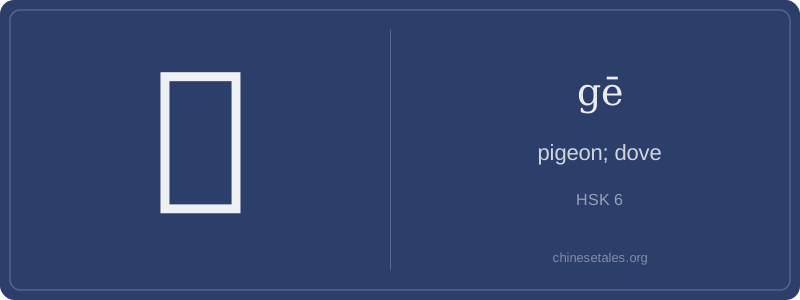
The earliest form of 鸽 doesn’t appear in oracle bones — it’s a later character, first attested in seal script (c. 3rd century BCE). Its left side, 合 (hé), originally depicted a lid closing over a vessel — suggesting containment, harmony, or fitting together. Paired with the right-side radical 鸟 (niǎo, ‘bird’), the full character visually merges ‘harmony’ and ‘bird’. Over time, 合 simplified: the top ‘lid’ (亼) and middle ‘mouth’ (口) condensed into today’s 合 component — still 6 strokes — while 鸟 retained its iconic avian shape: dot head, slanted beak, wings, tail, and feet. Stroke order matters: write 合 first (top to bottom, left to right), then 鸟 — never interweaving them.
Meaning-wise, 鸽 emerged not from observation of wild birds, but from domestication. Early Chinese texts like the *Erya* (3rd c. BCE) list 鴿 as a distinct species under ‘birds’, noting its homing instinct and gentle temperament. By the Tang dynasty, poets like Du Fu referenced 鸽哨 (gē shào, pigeon whistles) — bamboo reeds tied to pigeons’ tails that sang in flight — turning the bird into both a messenger and a musical instrument. The character’s ‘harmony + bird’ structure subtly reflects this duality: a creature that bridges sky and earth, war and peace, utility and beauty — all without uttering a sound.
Imagine walking through Beijing’s Temple of Heaven at dawn — dozens of gray pigeons flutter up from the marble balustrades, wings catching the light as they circle above the ancient cypress trees. In Chinese, this isn’t just ‘a bird’; it’s 鸽 (gē), a word that evokes quiet grace, peace, and urban familiarity. Unlike generic terms like 鸟 (niǎo, ‘bird’), 鸽 carries gentle connotations: doves in diplomacy, homing pigeons in wartime lore, even cheeky city pigeons pecking at baozi crumbs near Houhai. It’s always countable and nearly always used with classifiers like 一 只 (yī zhī) — you’d never say *一 鸽*.
Grammatically, 鸽 behaves like a standard noun but appears frequently in compound nouns (鸽子信, 鸽哨) or metaphorical expressions (‘pigeon English’ = pigeon English, i.e., simplified hybrid speech). Learners often mistakenly use it as a verb (*他鸽了我*), but that’s slang — derived from *gē* sounding like *gē* in *gē le*, a homophone-based internet abbreviation for 放鸽子 (fàng gē zi, ‘to stand someone up’). That playful usage is informal and context-sensitive — never in formal writing!
Culturally, 鸽 straddles reverence and realism: Confucian texts rarely mention it, yet its image appears on Ming-era porcelain and modern peace posters alike. A common error? Over-translating ‘dove’ as 鸽 in all contexts — but in poetic or biblical references (e.g., Noah’s dove), Chinese often prefers 白鸽 (bái gē, ‘white pigeon’) for symbolic purity, or even 鸽子 (gē zi) for warmth and colloquial flow. Remember: 鸽 alone is precise, neutral, and zoological — but add 子, and it softens, humanizes, and invites affection.