鹮
Character Story & Explanation
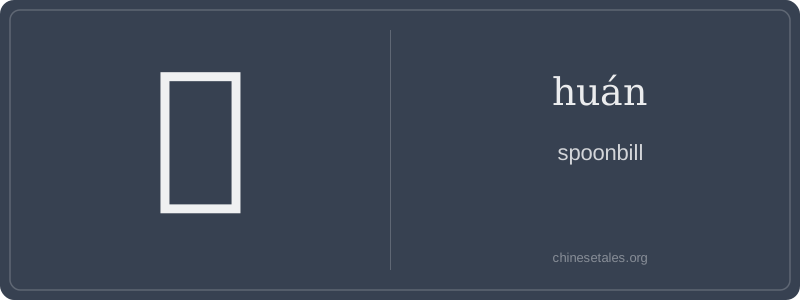
The earliest form of 鹮 doesn’t survive in oracle bones — it’s too late a coinage — but its structure tells a clear story. The left side, 昜 (yáng), is a phonetic component borrowed from characters like 揚 (*yáng*, ‘to lift/raise’) and 羊 (*yáng*, ‘sheep’), chosen here purely for sound (huán evolved from *yáng*-like pronunciations in Middle Chinese). The right side is 鸟 (*niǎo*), the ‘bird’ radical — unmistakable even in seal script, with its dot-eye, curved beak, and tail feathers. Stroke-by-stroke, the modern form locks in: the top horizontal of 昜 anchors the character, then three parallel strokes (like sunlight rays — fitting for a bird often seen glinting over water), followed by the compact, graceful 鸟 — 18 strokes total, each one evoking both flight and precision.
Historically, 鹮 entered written Chinese relatively late — likely Tang or Song dynasty — as naturalist observation deepened. Unlike classical birds like 雀 (*què*, sparrow) or 鹤 (*hè*, crane), which appear in poetry and philosophy, 鹮 was documented in regional gazetteers and medical texts (e.g., *Bencao Gangmu*) for its habitat near rivers and its distinctive bill used to sift mud. Its visual form — 昜 + 鸟 — subtly echoes its behavior: ‘sunlight’ (the reflective, open-water habitat) + ‘bird’, reinforcing how Chinese lexicographers linked ecology to etymology long before modern ecology existed.
At first glance, 鹮 (huán) feels like a rare, almost mythical character — and it is. It’s not in the HSK, not on street signs, and you’ll rarely hear it in daily conversation. But step into a wetland reserve or read a conservation report in Chinese, and suddenly 鹮 springs to life: it’s the elegant, long-legged, spoon-billed wading bird — the spoonbill — with that unmistakable flattened, spatulate beak. Its core meaning isn’t abstract or functional; it’s zoological precision. This is a *name* — a taxonomic label, not a verb or adjective. You won’t say ‘I 鹮’ or ‘very 鹮’ — it only appears as a noun, almost always modified (e.g., 白鹭 *bái lù* ‘egret’) or embedded in scientific or ecological contexts.
Grammatically, 鹮 behaves like other bird-noun characters under the 鸟 radical: it’s almost always preceded by a color or descriptor (白鹮 *bái huán*, 黑鹮 *hēi huán*) or paired in compounds like 鹮科 (*huán kē*, ‘spoonbill family’). Learners sometimes mistakenly treat it as a verb (‘to spoonbill’ — no such thing!) or confuse its tone (huán, second tone, *not* huǎn or huàn). Also, because it’s so rare, many native speakers mispronounce it — even journalists say ‘huǎn’ by analogy with 缓 — making accurate tone practice essential.
Culturally, 鹮 carries quiet gravitas: it’s an indicator species for healthy rivers and marshes, so in modern Chinese environmental writing, seeing 鹮 signals ecological hope — or alarm, if it vanishes. Its rarity in speech mirrors its biological vulnerability: several spoonbill species are endangered in China. So when you use 鹮, you’re not just naming a bird — you’re invoking wetlands, conservation, and the delicate balance of East Asian ecosystems.