年
Character Story & Explanation
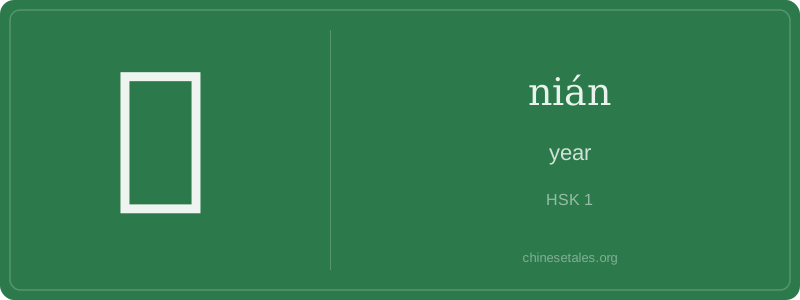
The earliest form of 年 appears in oracle bone inscriptions (c. 1200 BCE) as a vivid pictograph: a bent figure (, later simplified to 千) holding a bundle of ripe grain stalks — the top stroke representing heavy, drooping ears of millet or rice. This wasn’t just ‘time’—it was the *harvest year*, the annual cycle defined by agriculture. Over centuries, the grain bundle shrank into the top horizontal stroke (一), the bent figure evolved into the radical 干 (gān, originally meaning ‘shield’ but here acting phonetically and structurally), and the lower strokes stabilized into the modern six-stroke form — still unmistakably a person bowing under abundance.
This agrarian origin anchored 年’s meaning for millennia: in the *Classic of Poetry* (Shījīng), lines like ‘丰年多黍多稌’ (‘In bountiful years, much millet, much rice’) treat 年 as synonymous with harvest success. Even Confucius referenced ‘三年不改父之道’ (‘Not changing one’s father’s way for three years’) — using 年 not as abstract time, but as measured, meaningful cycles of duty and memory. Remarkably, the character’s shape has preserved that ancient bow — a quiet visual echo of humility before nature’s rhythm.
At its heart, 年 (nián) isn’t just a neutral unit of time like 'year' in English—it carries warmth, rhythm, and cultural heartbeat. In Chinese, 年 evokes harvest cycles, family reunions, lunar new year fireworks, and even age ('I am 25 years old' → 我二十五岁, where 年 is implied in 岁 but appears explicitly in phrases like 每年 or 几年). Its sound nián is soft and nasal—think of gently blowing out birthday candles: 'nee-ahn'—a little breathy, a little celebratory.
Grammatically, 年 is incredibly versatile: it’s a noun (今年 this year), a measure word for time spans (三年 three years), and part of fixed temporal phrases (每年 every year, 去年 last year). Crucially, it rarely stands alone as a subject/object without context—learners often say *‘年很好’ (‘Year is good’) thinking it means ‘This year is good,’ but that’s unnatural; instead, you’d say 今年很好. Also, note: 年 never takes the aspect particles 了 or 过 by itself—you say 我住了三年 (I lived there for three years), not *我住年了.
Culturally, 年 is inseparable from the Spring Festival—so much so that the character itself used to *be* the monster Nian (also pronounced nián) that villagers scared away with red paper and firecrackers! That myth lives on in the phrase 过年 (guò nián)—literally ‘to pass the Nian-monster,’ now meaning ‘to celebrate Chinese New Year.’ Learners sometimes overuse 年 when ‘age’ is needed (e.g., confusing 年龄 with just 年), or misplace it in time expressions—remember: quantity + 年 (e.g., 五 年), never 年 + quantity.