丞
Character Story & Explanation
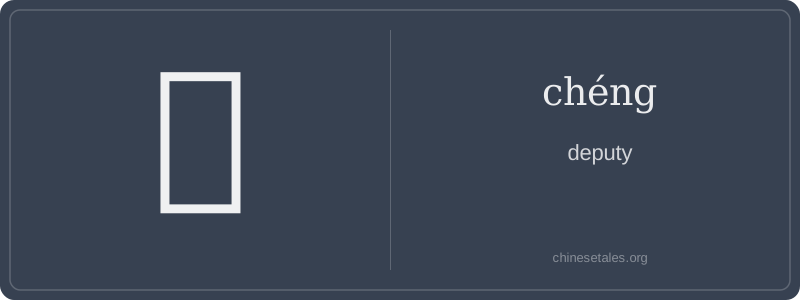
The earliest form of 丞 appears in late Shang oracle bones and Western Zhou bronzes as a pictograph showing a kneeling person () helping another person rise — arms extended upward beneath someone’s elbows. Over centuries, the kneeling figure simplified: the legs became two short horizontal strokes, the supporting arms evolved into the top '一' (horizontal line) and the bent elbow into the central '廾' shape — which later fused into today’s clean six-stroke form: 一 + 丿 + ㇏ + 丨 + 一 + 丶. The radical 一 isn’t arbitrary — it anchors the whole action, symbolizing the foundational support the deputy provides.
This visual origin directly shaped its meaning: 'to assist in rising' → 'to aid in governance' → 'deputy official'. By the Warring States period, 丞 was standard in bureaucratic titles like 县丞 (xiàn chéng, 'county deputy magistrate'). Mencius (3A:4) uses 丞 metaphorically: 'The ruler is the sun; his 丞 is the moon — not lesser light, but reflected, steady, indispensable.' Its enduring presence in titles like 丞相 (famously held by Zhuge Liang) cemented its association with wisdom-in-action, not just rank.
Think of 丞 (chéng) as the ancient Chinese equivalent of a 'Chief of Staff' — not just any assistant, but the trusted right-hand person who steps in when the boss is away, signs documents, and keeps the bureaucracy humming. It carries weight, quiet authority, and deep institutional trust — much like how 'deputy' in British Parliament implies legitimacy and delegated power, not mere subordination.
Grammatically, 丞 almost never stands alone in modern speech; it’s strictly a literary or formal compound character. You’ll find it only in fixed terms like 丞相 (chénɡ xiànɡ, 'chancellor') or historical titles (e.g., 少丞 — 'junior commissioner'). Learners mistakenly try to use it like a verb ('to deputy') or attach it freely — but no: it’s a fossilized noun root, like 'vizier' in English — evocative, precise, and utterly unproductive in new word formation.
Culturally, 丞 embodies Confucian administrative idealism: competence without ambition, loyalty without obsequiousness. A common pitfall? Confusing it with similar-looking characters (like 乘 or 易) — but more subtly, learners miss that 丞’s 'deputy' sense isn’t hierarchical inferiority; it’s functional equivalence under delegation. In classical texts, a 丞 could wield more real power than their nominal superior — a nuance lost if you translate it too literally as 'assistant'.