丫
Character Story & Explanation
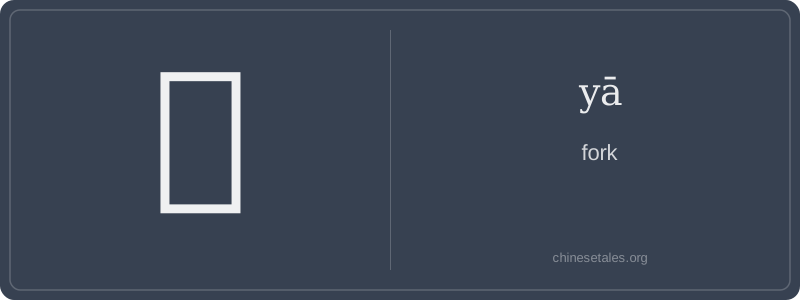
The earliest form of 丫 appears in Han dynasty clerical script (lìshū) as a stylized pictograph of a tree trunk splitting into two symmetrical branches — imagine a bare sapling viewed head-on: a vertical stem topped by two upward-curving limbs. Oracle bone and bronze inscriptions don’t contain 丫; it emerged later as a specialized character to capture that precise visual idea of bifurcation. Over centuries, the curves simplified into clean, angular strokes: first the central vertical line (丨), then two diagonal strokes radiating outward — one upper-left, one upper-right — forming the modern 丫. Its minimalism isn’t laziness; it’s distillation: three strokes, one unmistakable fork.
This visual clarity anchored its semantic evolution. In classical texts like the Shuōwén Jiězì (121 CE), 丫 was defined as 'the split top of a tree', reinforcing its botanical origin. By the Ming and Qing dynasties, it began appearing in vernacular fiction to describe hair parted in the middle (e.g., '丫髻', yājì — a traditional girl’s twin-bun hairstyle resembling a forked crown). That association with youthful female appearance gradually softened into the affectionate nickname usage we know today — a beautiful semantic drift from botany to endearment, all held together by the same elegant 'Y' shape.
At first glance, 丫 looks disarmingly simple — just three strokes forming a little 'Y' shape — and its core meaning is indeed 'fork': the point where something splits into two branches, like a tree limb, a road, or even hair parted down the middle. But here’s the twist: in modern spoken Chinese, 丫 rarely stands alone with that literal meaning. Instead, it’s almost always found in affectionate, colloquial terms — especially for young girls (e.g., 小丫, xiǎo yā), where it evokes a childlike, slightly rustic charm, like calling someone 'little sprout' or 'kidlet'. It carries warmth, familiarity, and a hint of folksy nostalgia — never formality.
Grammatically, 丫 functions only as a noun or a noun suffix; you’ll never see it as a verb or adjective. Crucially, it’s *not* used in formal writing or standard descriptions of physical forks (for that, use 叉, chā). Learners sometimes mistakenly insert 丫 into compound words like 'forklift' or 'pitchfork' — big no-no! Also beware: while 丫 can appear in names (e.g., 王丫丫, Wáng Yāyā), repeating it (丫丫) adds extra cuteness, not emphasis — unlike reduplication in many other nouns.
Culturally, 丫 taps into northern Chinese rural speech patterns and appears often in literature and film depicting childhood or countryside life (think Mo Yan or early CCTV dramas). A common learner trap? Confusing it with the number 八 (bā) — same stroke count, totally different shape and sound. And though it’s not in HSK, it pops up in real-life contexts like nicknames, folk songs, or dialect-heavy dialogue — so recognizing it helps you 'hear' authentic Chinese, not just textbook Mandarin.