丱
Character Story & Explanation
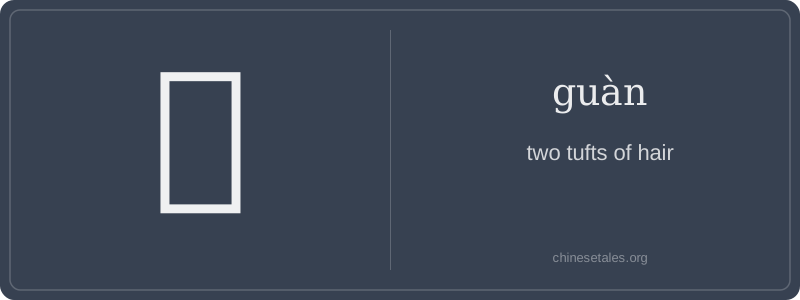
The earliest form of 丱 appears in bronze inscriptions as two upward-curving strokes flanking a central vertical line — a direct pictograph of a child’s head with two symmetrical hair buns tied high on either side, like miniature antlers. Over time, the curves simplified into sharp, angular 'V'-shaped strokes (the top two strokes), while the central line became the radical 丨 — not a mere stroke, but the child’s upright head and spine anchoring the playful tufts. By the Small Seal Script era, the shape stabilized into today’s five-stroke form: 丶 (dot-like starting point), then two diagonal strokes forming the 'V', then the vertical 丨, and finally the bottom horizontal stroke (一) — a subtle base suggesting the jawline or hairband holding it all together.
This visual logic stayed intact across millennia: 丱 never drifted from its hair-related meaning. In the Book of Rites (Lǐjì), it appears in descriptions of children’s attire; Sima Qian references 丱角 in the Records of the Grand Historian to evoke youthful promise before responsibility. Even today, when poets write of 丱年 (guàn nián), they aren’t just saying 'childhood' — they’re summoning the exact silhouette of a small person standing tall, hair lifted like wings, caught between play and duty.
Think of 丱 (guàn) as a tiny, elegant hairpin sketch — not a word you’ll need for ordering dumplings or booking train tickets, but one that opens a window into ancient Chinese aesthetics and childhood. Its core meaning is 'two tufts of hair', specifically the symmetrical, upward-swept child’s hairstyle worn by boys and girls before adulthood — like little horns or bunny ears. It’s not a verb or adjective you conjugate; it’s almost always used as a descriptive noun or in literary compounds, evoking innocence, youth, or classical elegance. You won’t hear it in daily speech — it’s a poetic fossil, preserved in texts and names.
Grammatically, 丱 functions like a visual noun: it appears in phrases such as 丱角 (guàn jiǎo), where it modifies 角 ('horn') to mean 'childhood' — literally 'horn-like tufts'. It never stands alone in modern usage; you’ll only encounter it in fixed expressions or classical allusions. Learners sometimes misread it as a variant of 卦 (guà, 'hexagram') or confuse its radical (丨) with 一, but 丱 has no connection to divination or numerals — it’s purely about hair, form, and age.
Culturally, this character embodies a vanished rite of passage: the moment before capping (guàn lǐ) — the Confucian coming-of-age ceremony for boys at 20. The hairstyle marked pre-adulthood, so 丱 subtly carries nostalgia, fragility, and fleeting youth. A common mistake? Pronouncing it ‘guān’ (like 冠) — but it’s *guàn*, with the fourth tone, echoing the weight of ritual. It’s not archaic because it’s obsolete — it’s archaic because it’s too precise, too visual, too tender for modern speed.