乑
Character Story & Explanation
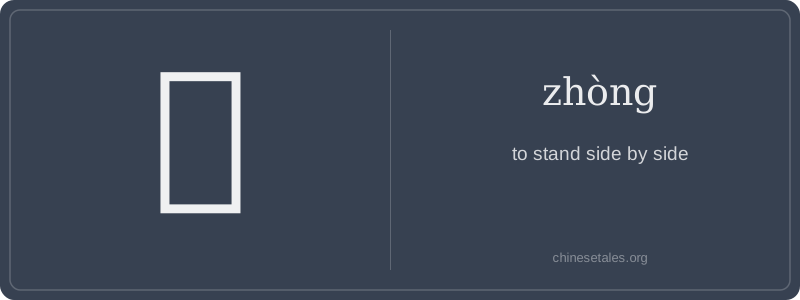
Carve this image into your mind: in oracle bone script (c. 1200 BCE), 乑 began as three identical, simplified human figures — each just a slanted stroke for the head and torso, plus a short downward stroke for the leg — standing tightly aligned, left to right, no gaps. No faces, no hands — just pure positional choreography. As bronze inscriptions evolved, the figures grew more angular and stylized; by the Small Seal Script era, the three ‘people’ had fused into three parallel 丿-like strokes leaning gently rightward, with two tiny supporting dots below — the earliest hint of the modern six-stroke form. The radical 丿 (piě, 'left-falling stroke') isn’t decorative: it’s the shared directional tilt — the visual echo of alignment.
This character’s meaning never wavered: from Shang dynasty divination bones to Han dynasty commentaries on ritual posture, 乑 consistently described bodies occupying adjacent, equal, coordinated space — not crowding, not leading, not following, but *co-presencing*. In the Shuōwén Jiězì (100 CE), Xu Shen defined it as ‘three persons standing together, mutually supportive’ — emphasizing relational balance over number. Even in late imperial poetry, 乑 was reserved for moments of sacred synchrony: soldiers before battle, scholars at a rites ceremony, or pine trees growing in unison on a cliff — always quiet, always collective, always still.
Let’s be real: 乑 (zhòng) is a quiet rebel — it means 'to stand side by side', but you’ll almost never see it in modern spoken Chinese or beginner textbooks. Why? Because it’s functionally obsolete as an independent word, yet it pulses with ancient logic. Visually, it’s six strokes that look like three people leaning into each other — not stacked vertically like 列 (liè, 'to line up'), but *shoulder-to-shoulder*, facing the same direction. That sideways unity is its soul: it evokes collective presence without hierarchy, intimacy without fusion.
Grammatically, 乑 appears only in classical compounds or poetic contexts — never alone in a sentence today. You won’t say *‘I 乑 with my friends’*; instead, you might read 乑立 (zhòng lì) in a Tang dynasty poem meaning ‘standing shoulder-to-shoulder in solemn unity’. It behaves like a verb root, but only in fixed, literary collocations — think of it as Chinese’s rarest ‘silent consonant’: essential to the etymological harmony of a word, but never voiced on its own.
Culturally, learners often mistake 乑 for a variant of 众 (zhòng, ‘many’) because of the shared pronunciation and crowd-related meaning — but that’s a trap! 众 has 目 (eye) under 入 (enter), picturing ‘many eyes watching’, while 乑 is purely gestural: three human silhouettes in profile, arms slightly bent, sharing space. The biggest mistake? Assuming it’s usable in modern speech. It’s not — it’s a fossilized glyph, beautiful in its stillness, like a bronze bell you admire but never ring.