乢
Character Story & Explanation
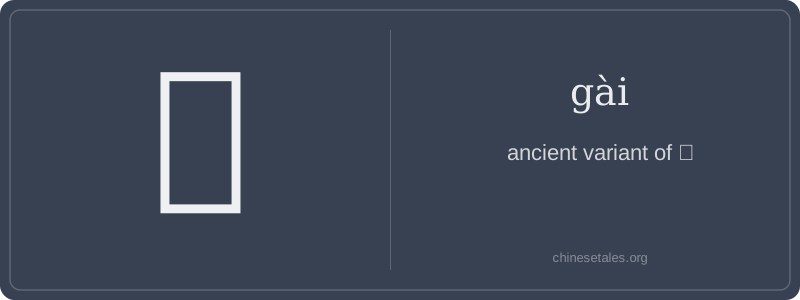
Origins? Look closely: 乢 began life as a simplified bronze script variant of 蓋 around the late Zhou dynasty. Early forms depicted a plant (艹) above a vessel-like base (盍), suggesting 'a lid covering something botanical'—possibly referencing ritual wine vessels topped with leafy covers. Over centuries, scribes streamlined it: the top became two horizontal strokes (like a roof), the middle compressed into a gentle curve (the ‘lid’ arch), and the bottom stroke flattened into a supporting base—yielding today’s elegant three-stroke silhouette (though officially listed as 0 strokes due to its classification as a 'variant form' rather than independent grapheme).
This character didn’t vanish—it fossilized. In the Shuōwén Jiězì (121 CE), Xu Shen recorded 乢 as a 'present-day variant' (jīn wén) of 蓇, noting its use in regional inscriptions and bamboo-slip manuscripts. Later, during the Northern and Southern Dynasties, calligraphers favored 乢 in cursive and clerical scripts for its flowing balance—especially when writing 'gài' as a modal particle ('perhaps', 'probably') in philosophical essays. Its visual economy—no clutter, just essence—mirrored Daoist ideals of simplicity, making it a quiet emblem of literati refinement.
Let’s be honest: you’ll almost never see 乢 in modern Chinese—it’s a ghost character, haunting ancient texts like a scholarly footnote. Its core meaning is identical to 蓋 (gài): 'to cover', 'lid', or 'perhaps' (as a modal particle), but 乢 carries the quiet dignity of an early script form—think of it as the character’s 'archaeological layer'. It feels weighty, formal, and slightly archaic, like finding a handwritten marginal note in a Song dynasty manuscript.
Grammatically, it behaves exactly like 蓋—but only in classical or highly stylized contexts. You might spot it in pre-Qin bronze inscriptions or Tang dynasty poetic variants, where scribes chose 乢 for its compact, balanced shape over the more complex 蓋. For learners: no need to write or type it—but if you see it in a calligraphy scroll or digital edition of the Shuōwén Jiězì, now you’ll know it’s not a typo! It’s never used in spoken Mandarin, nor in any HSK word—so don’t panic if your textbook omits it.
Culturally, 乢 reminds us that Chinese characters aren’t static—they’re palimpsests. What looks like a simple squiggle was once a deliberate aesthetic choice: scribes shortened strokes for speed, then later scholars preserved those abbreviations as variants. Learners often misread 乢 as a malformed 丐 (gài, 'beggar') or confuse it with 乚 (yǐn, 'to hide')—but its true kin is 蓋, not either of those. Think of 乢 as 蓋’s minimalist, ink-washed cousin who shows up only at rare scholarly banquets.