乪
Character Story & Explanation
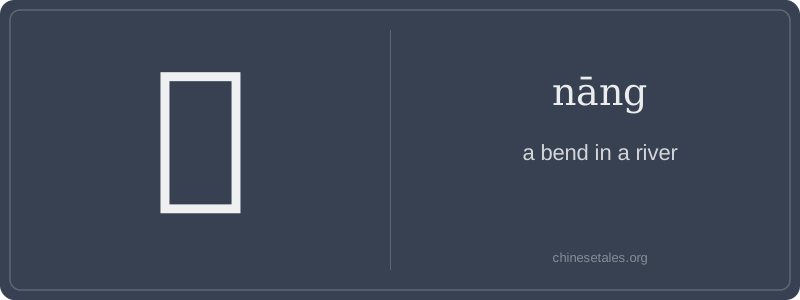
The character 乪 has no attested oracle bone or bronze script form — it’s a late, localized invention, likely emerging in Southern Chinese dialectal writing during the Ming–Qing period. Its shape is deliberately schematic: two soft, parallel curves (like parentheses facing each other: ( ) ) joined by a gentle horizontal stroke — a minimalist pictograph of water slowing, pooling, and turning. Unlike ancient characters carved into bone or cast in bronze, 乪 was drawn with brush on paper or bamboo slips, its flowing lines echoing the very bend it names. There are no standard stroke order rules because it wasn’t standardized — scholars treated it as a ‘dialect logogram’, not a canonical character.
Historically, 乪 appears only in local gazetteers, poetry inscriptions along the Pearl River Delta, and hand-copied clan records — always marking actual geographic features, like 乪灣 (Nāngwān), a historic bend near Foshan. Its meaning never broadened: it never came to mean 'curve' in abstract contexts (unlike 曲), nor did it acquire metaphorical extensions (e.g., 'a twist in fate'). Its visual form *is* its meaning: no strokes wasted, no ambiguity — just water bending, drawn once, perfectly.
Think of 乪 not as a character, but as a cartographer’s doodle — the kind you’d scribble in the margin of an old map to mark where a river curls like a sleeping cat’s tail. In Chinese, it’s a poetic, hyper-specific noun meaning 'a bend in a river' — not just any curve, but one with gentle, meandering grace, often evoking stillness, reflection, and quiet transition. It carries no verb or adjective function; it’s purely nominal and literary, almost fossilized in modern usage — like finding the word 'knaveship' in contemporary English.
Grammatically, 乪 appears almost exclusively in classical-style phrases or place names (e.g., 乪頭村), never in everyday speech or HSK-level texts. You won’t conjugate it, pluralize it, or stack it into compound verbs. It stands alone — like a single brushstroke in an ink painting: precise, intentional, and unrepeatable. Learners sometimes try to force it into sentences like 'the river 乪s', but it has no verb form — that’s a classic false-friend trap rooted in expecting Chinese to mirror English grammar.
Culturally, 乪 embodies the Daoist reverence for natural flow and subtle change — a bend isn’t a deviation, but a necessary yielding to terrain. It’s absent from dictionaries like Xiāndài Hànyǔ Cídiǎn and rarely taught outside specialist paleography or regional linguistics courses. Mistaking it for a variant of 乙 or 乃 is common — but those are functional grammatical particles; 乪 is pure topography, frozen in glyph-form.