亄
Character Story & Explanation
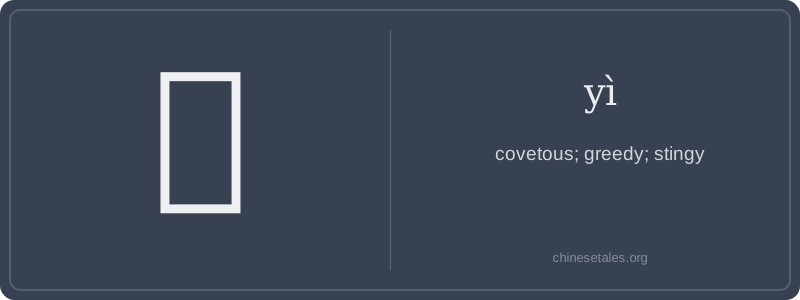
The character 亄 does not appear in oracle bone or bronze inscriptions—it’s a late, rare creation first attested in the *Shuōwén Jiězì* (c. 100 CE), where Xu Shen classifies it under the radical 乙 (yǐ), the second of the Ten Heavenly Stems. Visually, it’s minimalist: just 乙 (a curved stroke symbolizing 'second' or 'bend') with a tiny dot (丶) added above its right curve. That dot isn’t decorative—it’s a semantic marker, representing a 'focused eye' or 'fixed gaze' upon something desired. Over centuries, the dot hardened into a distinct stroke, while the 乙 became slightly more angular, yielding today’s sleek, unadorned form—two strokes total, yet radiating moral weight.
Its meaning crystallized in Han dynasty moral philosophy: not mere hunger, but *intentional fixation on acquisition*, especially at others’ expense. The *Huáinánzǐ* (2nd c. BCE) uses 亄 to describe rulers who hoard grain while people starve; Ban Gu’s *Book of Han* cites it in critiques of corrupt ministers. Crucially, 亄 implies *self-aware, willful greed*—not weakness, but vice. Its visual sparseness mirrors its conceptual sharpness: no extra strokes, no ambiguity—just the bare anatomy of avarice. No wonder it vanished from daily use: it’s too precise, too biting, for polite conversation.
Think of 亄 as Chinese literature’s version of Scrooge McDuck diving into his money bin—but with zero charm and all the judgment. It doesn’t just mean 'greedy'; it carries a moral sneer, like calling someone 'grasping' or 'miserly' in Victorian English—less about appetite, more about ethical failure. In classical usage, it’s almost exclusively adjectival and literary: you’ll find it in moral essays, historical critiques, or poetic rebukes—not in casual speech or modern news. You won’t hear 'Wǒ hěn 亄' (I’m greedy); instead, it modifies nouns or appears in set phrases like 亄夫 (a covetous man), always carrying an air of condemnation.
Grammatically, 亄 behaves like an archaic adjective—it rarely stands alone, never takes aspect markers (了, 过), and almost never pairs with degree adverbs like hěn or tài. A learner might mistakenly plug it into a sentence like 'Tā hěn 亄', but that would sound jarringly unnatural, like saying 'He is very avaricious' in English—grammatically possible, stylistically absurd. Instead, it appears in tightly bound compounds or as a modifier before nouns or pronouns: 亄者 (the greedy one), 亄心 (covetous heart).
Culturally, 亄 belongs to a family of characters (like 貪, 奢, 吝) that encode Confucian virtue ethics—where desire isn’t neutral, but a test of self-cultivation. Its near-total absence from modern spoken Mandarin and the HSK lists tells you everything: this is a word for annotating moral decline, not ordering lunch. Learners often misread it as 易 (yì, 'easy') due to identical pronunciation and similar stroke economy—but 易 has a sun-and-moon radical and means the opposite of moral austerity.