亘
Character Story & Explanation
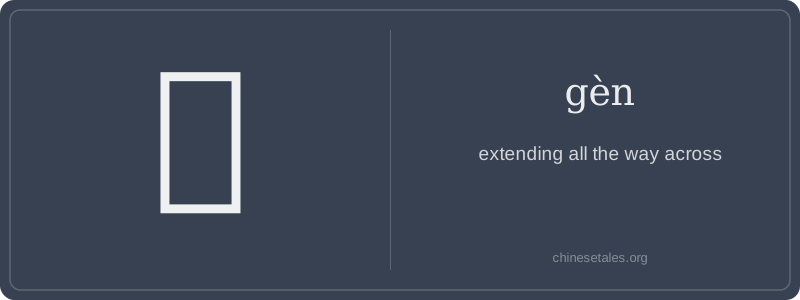
The earliest form of 亘 appears on Western Zhou bronze inscriptions as a symmetrical, elongated glyph: two parallel horizontal lines (like horizon lines) connected by a vertical stroke in the center — resembling a taut rope stretched between two posts or a bridge anchored at both ends. Over centuries, the central vertical softened into a slight curve, then vanished entirely in seal script, leaving only the top and bottom horizontals plus the two short side strokes — evolving into today’s clean, balanced six-stroke structure: 一 + 丿 + 一 + 一 + 丶 + 一. Its oracle bone roots may even echo ancient boundary markers — stones placed end-to-end across land to denote unbroken territorial claim.
This visual logic directly birthed its meaning: 'to extend without break across space.' By the Warring States period, texts like the *Zhuangzi* used 亘 metaphorically — e.g., 亘于无穷 ('extending into infinity') — elevating it from cartographic description to philosophical abstraction. In Tang poetry, it described mountains '亘天际' (stretching to the sky’s edge); in Ming dynasty maps, it labeled rivers '亘东南' (spanning southeast). Even today, when a geographer writes 亘山脈 (gèn shānmài), they’re not just naming a range — they’re invoking its unyielding, horizon-defying presence.
Think of 亘 (gèn) as the Chinese word for 'stretching forever' — not in time, but in space: a mountain range that vanishes into both horizons, a river cutting straight across a map, a bridge spanning a chasm. It’s poetic, formal, and deeply visual: it doesn’t just mean 'across' — it means *unbrokenly* across, with weight, continuity, and quiet authority. You’ll almost never hear it in casual speech; it lives in literature, geography textbooks, and solemn inscriptions — like the phrase 亘古不变 (gèn gǔ bù biàn), 'unchanged since ancient times.' Notice how it modifies nouns or verbs directly, often as an adverbial modifier (e.g., 亘于天地之间 — 'stretches between heaven and earth').
Grammatically, 亘 is almost always a verb meaning 'to extend continuously across,' and it’s nearly always transitive — it needs something to stretch *across*. Learners sometimes mistakenly use it like the common preposition 跨 (kuà) or even 横 (héng), but 亘 carries no motion — only serene, immovable span. It’s also never used alone; it appears in fixed compounds or classical-style phrases. Try saying 亘在眼前 — 'stretches unbroken before your eyes' — and feel how the character itself looks like two horizontal lines (the radical 二) holding up a long, steady bar (the top and bottom strokes): stability incarnate.
Culturally, 亘 evokes Daoist and geomantic ideas of enduring cosmic alignment — think of the Great Wall snaking across northern ridges, or the Milky Way arching over ancient star charts. A common mistake? Confusing it with 亘’s lookalike 旦 (dàn, 'dawn') — same stroke count, similar shape, but 旦 has a sun (日) inside, while 亘 is hollow and horizontal. Also, don’t pronounce it gēn or gěn — the tone is fourth, sharp and falling, like a line drawn decisively from left to right.