亨
Character Story & Explanation
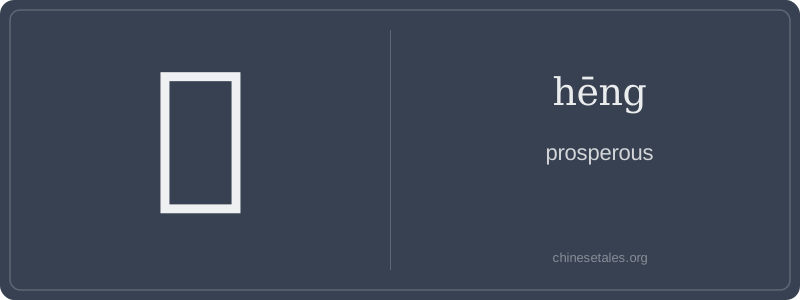
The earliest form of 亨 appears in Shāng dynasty oracle bone inscriptions as a stylized depiction of a sacrificial vessel — specifically, a covered bronze cauldron (dǐng) with steam rising upward, symbolizing offerings ascending smoothly to heaven. Over time, the top simplified into the radical 亠 (a ‘lid’ or ‘canopy’), the middle became the vertical stroke representing the vessel’s body, and the lower part evolved from three horizontal strokes (steam or grain) into the distinctive ‘xiǎo’ (小) shape — not meaning 'small', but echoing the vessel’s base and lid closure. By the Qin seal script, it had stabilized into today’s seven-stroke form: 亠 + one vertical + 小.
This visual logic directly shaped its meaning: smooth ascent = harmonious communication between human and divine = auspicious success. In the Yìjīng, hexagram 32 (Héng) uses the same phonetic component, reinforcing continuity and natural flow. Later, in the Shūjīng (Book of Documents), it appears in phrases like 'wàn bāng xié hēng' ('all states flourish in harmony'), linking political stability to cosmic order. Even today, when a feng shui master adjusts a door’s orientation for 'qì hēng tōng' (smooth qi flow), they’re invoking this 3,000-year-old image of steam rising — unhurried, clear, and perfectly aligned.
At its heart, 亨 (hēng) is the ancient Chinese concept of smooth, unimpeded flow — like a river gliding through a valley or qi circulating freely in the body. It’s not just 'prosperous' in the modern economic sense; it’s about cosmic harmony, auspicious alignment, and effortless success. Think less 'I got a promotion' and more 'the stars, the ancestors, and your effort all clicked perfectly.' In classical texts, it appears constantly in the Yìjīng (I Ching), where hexagram 32 (Héng) shares its phonetic root — signaling enduring, natural flourishing.
Grammatically, 亨 is almost never used alone in modern speech — it’s a literary, formal, or ritual word. You won’t hear it in casual chat, but you *will* see it carved on temple lintels ('yǒu qiǎn bì hēng' — 'with sincerity, all endeavors prosper'), stamped on red envelopes during Lunar New Year, or embedded in four-character idioms like 'zhì dà cái hēng' (great wisdom, smooth success). Learners often mistakenly treat it as a verb ('to prosper') or confuse it with common verbs like 'xīng' (to thrive); but 亨 functions almost exclusively as an adjective or adverbial complement — always elevated, never colloquial.
Culturally, 亨 carries deep Daoist and Confucian resonance: prosperity that arises not from force, but from alignment with the Way (Dào) and proper conduct (lǐ). A classic mistake is overusing it in writing — sounding pompous instead of auspicious. Also, watch the tone: hēng (first tone) is auspicious; hēng (fourth tone, rare) means 'to cook' — but that usage is archaic and nearly extinct. So unless you’re translating Warring States bamboo slips, stick to hēng.