仞
Character Story & Explanation
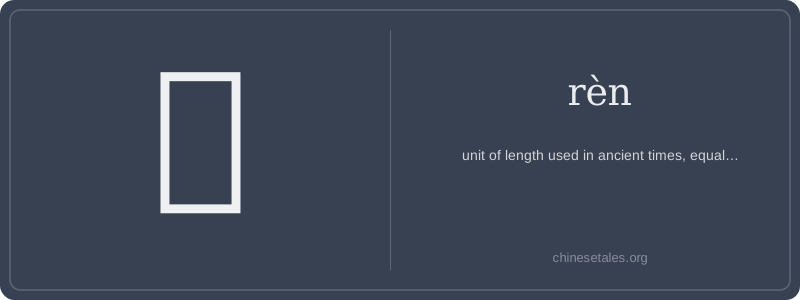
The earliest form of 仞 appears in bronze inscriptions as a combination of 人 (person) and 刃 (blade/edge), but not as a weapon — rather, a stylized depiction of a *person reaching upward with arms extended toward a sharp, defined height marker*, like a carved line on a cliff face or a tally notch on a measuring pole. Over centuries, 人 simplified into the left-side radical 亻, while 刃 lost its dot and sharpened into the right-side component — now written as + 丿, visually echoing the ‘cut-off’ or ‘defined limit’ of a measurement. By the seal script era, it had stabilized into the five-stroke shape we know today: two strokes for the person-radical, three for the ‘edge-limit’.
This visual logic became semantic truth: 仞 didn’t just mean ‘length’ — it meant *a human-scaled, yet monumental, vertical measure*. In the *Analects* and *Mencius*, it appears only when describing cliffs, city walls, or moral cultivation — always implying something vast *relative to human effort*. Its persistence in idioms like ‘九仞’ isn’t nostalgia; it’s linguistic fossilization — a unit so evocative that even after it vanished from practical use, poets kept it alive to conjure scale, struggle, and the sublime.
Think of 仞 not as a number, but as a *feeling* — the awe you get standing at the base of a cliff and craning your neck to see the top. It’s an ancient Chinese unit of length (7 or 8 chi, roughly 2.1–2.4 meters), but it almost never appears in isolation. You’ll only encounter it in classical idioms, poetic descriptions of height, or philosophical metaphors — never on a ruler or in a market. Its core vibe is *impressive vertical scale*, often with emotional weight: towering mountains, unattainable ideals, or overwhelming difficulty.
Grammatically, 仞 functions like a measure word attached directly after a numeral (e.g., 九仞 ‘nine rèn’), but crucially, it *never takes 的*. You say 九仞高山, not *九仞的高山*. Learners sometimes misread it as a noun meaning ‘height’ — but it’s strictly a *unit*, like ‘foot’ or ‘fathom’. Also, it’s always used in the *positive* direction: you climb *up* nine rèn, dig *down* nine rèn — but you’d never say ‘five rèn wide’ (that’s 丈 or 米). And yes — it’s pronounced rèn, rhyming with ‘earn’, not ‘rent’.
Culturally, 仞 lives in the realm of literary elegance and moral gravity. The famous Confucian saying ‘为山九仞,功亏一篑’ (‘Building a mountain nine rèn high — ruined by one basket short’) uses it to evoke the crushing weight of near-success failure. Modern speakers rarely use it literally; misusing it in daily speech sounds like quoting poetry at a coffee shop — charming, but wildly out of place. That’s why it’s absent from HSK: it’s not about communication, but about reading the classics and feeling the texture of Chinese thought.