仡
Character Story & Explanation
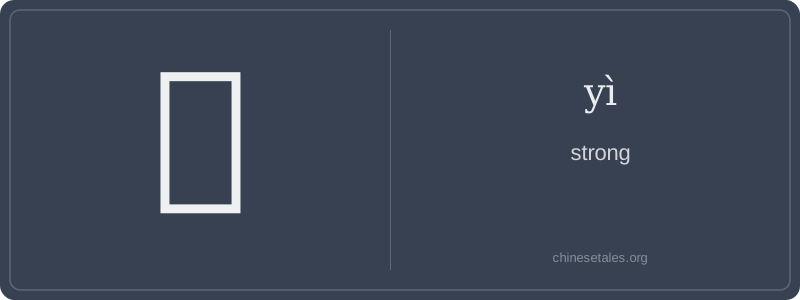
The earliest form of 仡 appears in late Warring States bamboo slips and Han dynasty seals — not as a pictograph, but as a phonosemantic compound. Its left side 亻 (rén bàng) is the 'person' radical, anchoring human agency; the right side 戊 (wù), an ancient weapon-shaped ideograph representing military authority and fortitude, evolved into the modern 乙-like shape through clerical script simplification. Originally, 戊 depicted a broad-bladed halberd — a symbol of command and unassailable power — and when paired with 人, it conveyed 'a person of martial strength and steadfast presence'. Over centuries, the sharp angles softened, strokes condensed, and 戊 morphed visually into 乙, but the semantic echo of 'unbending human strength' held firm.
By the Tang and Song dynasties, 仡 had shifted from general 'strength' to ethnonymic specificity. Classical texts like the Mèngqiū (10th c.) used it in phrases like 仡然 (yì rán) — 'standing tall and resolute' — describing dignitaries’ posture. But its most enduring role emerged in Ming-Qing ethnographic records, where officials adopted 仡 to phonetically render the Gelao people’s self-designation. This wasn’t arbitrary: the Middle Chinese pronunciation /*ŋɨt/ matched local pronunciations closely. So while the character’s visual origin is martial, its historical life became anthropological — a rare case where a single character serves both as a semantic relic and a phonetic vessel for Indigenous identity.
仡 (yì) is a rare but vivid character meaning 'strong', 'robust', or 'vigorous' — but don’t reach for it in everyday speech. It’s not about gym muscles or brute force; it evokes an ancient, almost mythic strength: the unyielding resilience of mountain clans or the dignified bearing of elders. You’ll rarely see it solo — it almost always appears in fixed compound forms, especially ethnolinguistic terms like 仡佬族 (Gēlǎo zú), the official name for the Gelao people of southern China. Grammatically, 仡 never functions as a verb or adjective on its own — no '他很仡' (❌). Instead, it’s fossilized in proper nouns and literary compounds, where it contributes tone and cultural weight rather than dictionary definition.
Here’s the trap: learners hear 'yì' and think of common homophones like 易 (easy), 意 (meaning), or 义 (righteousness) — all high-frequency HSK words. But 仡 carries zero semantic overlap with those. Its usage is tightly bound to identity and heritage, not abstraction or daily description. Even native speakers often mispronounce it as yǐ or yí outside ethnic contexts — because they’ve only encountered it in official documents or maps, not conversation.
Culturally, 仡 is a quiet act of linguistic preservation. It’s one of the few characters retained *specifically* to transcribe the autonym of the Gelao people (who call themselves /klau/ or /kau/ — approximated by 仡 in Middle Chinese phonology). That makes it less a 'word' and more a phonographic anchor — a bridge between oral tradition and written record. For learners, the takeaway isn’t vocabulary acquisition, but awareness: this character is a living artifact, not a building block.