仳
Character Story & Explanation
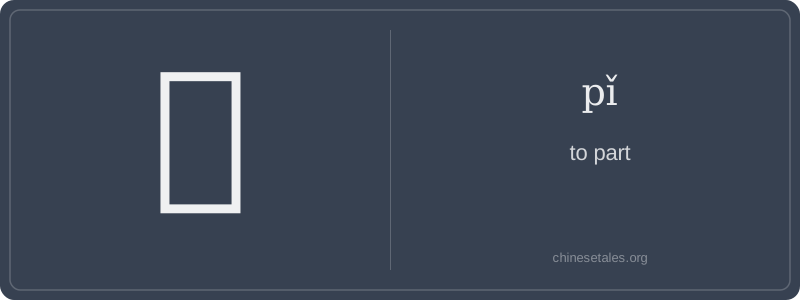
Oracle bone inscriptions don’t show 仳 — it emerged later, during the Warring States period, as a stylized compound. Its left side, 亻 (rén bàng), is the 'person' radical — no surprise there. The right side, 比 (bǐ), originally depicted two people facing each other, arms interlocked in ritual embrace or mutual comparison. Over centuries, 比 simplified from twin kneeling figures into two parallel strokes — but crucially, in 仳, those strokes are *not* equal: the top stroke curves down, the bottom strokes curve up, subtly suggesting divergence, not symmetry. By the Han dynasty seal script, the two 'people' had drifted apart — visually echoing the meaning.
This visual metaphor became semantic reality: when two people who once stood 'side by side in harmony' (比) now stand 'as persons moving away' (亻 + 比), the result is 仳 — parting with finality. Classical texts rarely use it alone, but the *Shuōwén Jiězì* (121 CE) defines it precisely as 'separation of husband and wife' (夫婦相離). In Tang poetry, 仳 appears in lines lamenting exiled officials severed from court and family — always implying moral rupture, not mere distance. Its form didn’t just record meaning; it *enacted* it: two figures, once aligned, now pulling in opposite directions.
Let’s get real: 仳 (pǐ) isn’t a character you’ll see on subway ads or hear in beginner dialogues — it’s a quiet, literary ghost of separation. Its core meaning is 'to part' — not just physically, but emotionally, irrevocably: think divorce, estrangement, or the final silence after a lifelong bond fractures. It carries weight and sorrow; it’s never casual. You won’t say 'we 仳'd last week' — that would sound like quoting a Tang dynasty elegy. Instead, it appears almost exclusively in formal or classical contexts: legal documents, poetry, or solemn commentary on broken relationships.
Grammatically, 仳 is almost always used in compounds — standalone use is archaic and jarring. You’ll encounter it in verbs like 仳离 (pǐ lí), where 仳 intensifies the sense of definitive, sorrowful separation beyond ordinary 离 (lí, 'to leave'). Note: it’s *never* used as a transitive verb with an object (e.g., ❌'仳他' is ungrammatical). It only works in set phrases, often paired with other disyllabic verbs or nouns. Learners sometimes misread it as 'pī' (like 辟) — but the third tone (pǐ) is essential: it’s the falling-rising tone of resignation, not the sharp first tone of command.
Culturally, 仳 echoes Confucian ideals of harmony and continuity — its very existence highlights how deeply Chinese tradition values relational wholeness. When 仳 appears, something fundamental has ruptured. Modern writers use it sparingly, almost ritually, to evoke gravity — like choosing 'bereavement' over 'sadness'. A common mistake? Assuming it’s interchangeable with 分 (fēn, 'to divide') or 别 (bié, 'to part'); those are neutral or even positive (e.g., 别开生面, 'to break new ground'), while 仳 is inherently tragic and irreversible.