伭
Character Story & Explanation
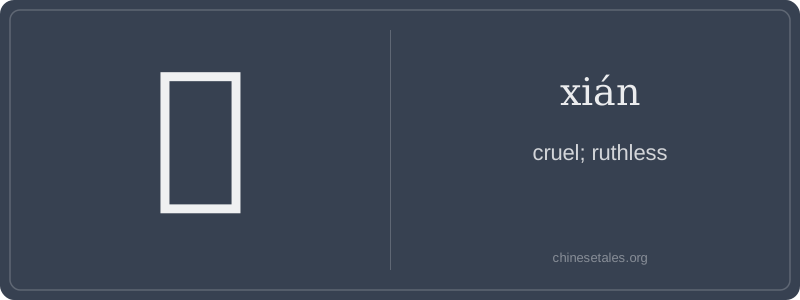
The earliest attested form of 伭 appears in late Warring States bamboo slips—not as a pictograph, but as a phonosemantic compound: the left radical 亻 (rén, 'person') fused with the right component 弦 (xián, 'bowstring'), which served both sound and symbolic function. In bronze script, 弦 depicted a taut bowstring stretched across a wooden arc—the visual metaphor for tension, precision, and lethal readiness. Scribes simplified 弦’s complex strokes over centuries, dropping the bow (弓) and retaining only the string (玄) plus the 'heart-mind' indicator 心 beneath, eventually merging into today’s 伭. By Han times, the character had stabilized with its current eight-stroke structure.
This evolution reflects meaning drift: from 'taut as a bowstring' → 'unyielding in judgment' → 'emotionally detached cruelty'. Classical texts like the Han Feizi use 伭 to describe laws applied with mechanical impartiality—neither merciful nor vengeful, just inexorable. The 'person + bowstring' composition thus encodes a profound philosophical idea: true ruthlessness isn’t hot-blooded fury, but cold, calibrated force—like an archer releasing an arrow without flinching. This nuance survives in modern usage: 伭 never implies madness or passion; it implies control, intention, and terrifying clarity.
Imagine a stern magistrate in a Ming-dynasty courtroom, eyes sharp as flint, sentencing a corrupt official—not with rage, but with icy, unblinking finality. That’s the essence of 伭 (xián): not mere anger, but a chilling, deliberate cruelty—calculated, unsentimental, and morally detached. It’s the adjective that describes a tyrant who executes dissenters 'for stability', or a CEO who liquidates a factory without blinking. Unlike common synonyms like 残忍 (cánrěn) or 凶残 (xiōngcán), 伭 carries literary weight and classical austerity—it rarely appears in speech or modern news; you’ll find it mostly in historical novels, classical poetry, or scholarly critiques of authoritarianism.
Grammatically, 伭 functions almost exclusively as a stative adjective before nouns (伭心, 伭吏) or in compound adjectives (伭酷, 伭厉). It *never* stands alone predicatively ('He is 伭' is ungrammatical); instead, you’d say 他心性伭酷 (tā xīnxìng xiánkù)—'His nature is ruthlessly cruel.' It cannot take aspect markers (了, 过) or degree adverbs like 很—it pairs only with archaic intensifiers like 极 (jí) or 太 (tài), as in 极伭 (jí xián). Learners often mistakenly use it like 残忍 in casual contexts—a faux pas that makes their Mandarin sound like a wuxia villain quoting ancient edicts.
Culturally, 伭 evokes Confucian-Mohist debates on benevolence: Mencius condemned rulers whose policies were 伭 because they lacked rén (benevolence), while Legalist texts sometimes praised 伭 as necessary for order. Its rarity today makes it a linguistic time capsule—deploying it signals deep classical literacy or deliberate stylistic archaism. Mispronouncing it as xiǎn (like 显) or confusing it with 闲 (xián, 'leisure') instantly reveals non-native footing—so listen closely to that second-tone glide.