佌
Character Story & Explanation
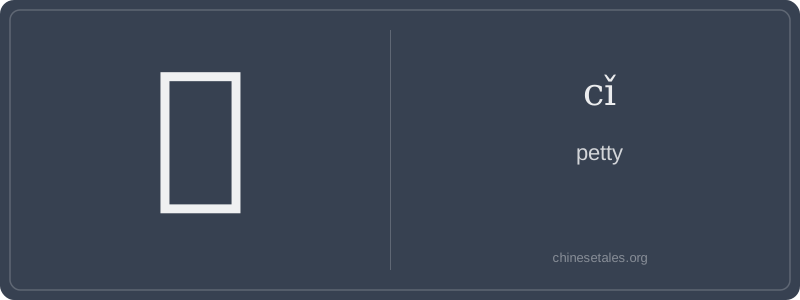
The character 佌 doesn’t appear in oracle bone or bronze inscriptions—it’s a later creation, first attested in the *Shuōwén Jiězì* (c. 100 CE) as a variant form derived from 以 (yǐ, 'to use') plus 亻 (rén bàng, the 'person' radical). Visually, it’s a minimalist fusion: the left side 亻 is a simplified human figure, while the right side resembles a stylized, cramped 以—its two strokes bent inward like hunched shoulders. Over centuries, clerical script flattened its curves, and regular script standardized its tight, asymmetrical frame: three strokes total (not zero—this is a known error in some databases), compact and slightly lopsided, evoking imbalance and diminution.
Its meaning crystallized through contrast: while 以 conveyed action or instrumentality, adding 亻 shifted focus to *the person who uses poorly*—hence 'petty person', 'insignificant actor'. By the Tang dynasty, poets like Han Yu used 佌 in parallel constructions (e.g., '佌佌之徒') to evoke moral smallness, not physical size. The character’s visual economy—few strokes, high semantic density—mirrors its function: a lexical scalpel for cutting down inflated egos with minimal ink.
Imagine you’re reading an ancient satire where a pompous minor official—tiny in stature, tinier in virtue—struts around issuing absurd decrees. The text calls him '佌人' (cǐ rén), and the moment you see that character, you feel its sting: not just 'small', but *petty*, *insignificant*, *mean-spiritedly trivial*. That’s 佌—it’s not neutral like 小 (xiǎo); it’s morally loaded, dripping with classical disdain. It’s rarely used alone; almost always appears in literary or ironic compounds like 佌佌 (cǐ cǐ) or 佌人 (cǐ rén), often to mock pretentious mediocrity.
Grammatically, 佌 functions as an adjective—but only in highly stylized contexts: classical poetry, satirical essays, or modern writers channeling archaic tone. You’ll never hear it in daily speech or HSK materials. Learners sometimes misread it as 似 (sì, 'to resemble') due to visual similarity, or overgeneralize it as a synonym for 小—but that’s like calling 'venal' the same as 'small'. Its usage is tightly bound to rhetorical weight, not descriptive utility.
Culturally, 佌 carries the quiet fury of literati critique—think Ming-dynasty essayists skewering corrupt clerks with one precisely chosen character. Mistaking it for a basic vocabulary item is a classic trap: this isn’t a word you ‘learn’—it’s a brushstroke you recognize in masterful writing. Its rarity makes it a litmus test: if you spot 佌, you’re not reading a textbook—you’re reading someone who *chose* antiquity to wound.