每
Character Story & Explanation
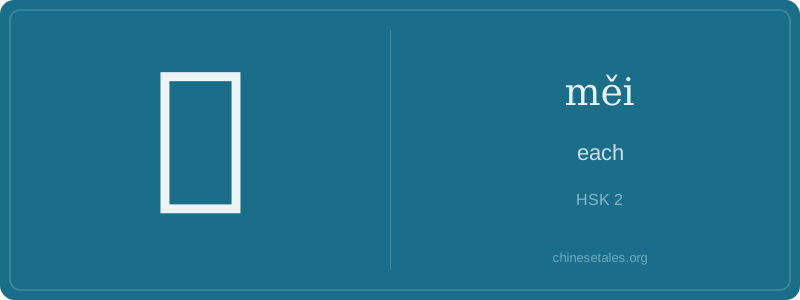
The earliest form of 每 appears in Western Zhou bronze inscriptions — not as today’s elegant shape, but as a stylized depiction of a woman (母) wearing an ornate headdress with three decorative plumes or feathers rising upward. That top element evolved into the modern (like a tilted 'T') — originally representing ceremonial headgear. The lower part remained 母 (mǔ), meaning 'mother', symbolizing source, origin, and generative abundance. Over centuries, the plumes simplified into two short horizontal strokes and a dot (the '一、一、丶' at the top), while 母 streamlined its inner strokes — losing the two dots inside its 'U'-shaped frame, leaving only the central vertical stroke and curved arms we see today.
This visual logic is brilliant: 'mother' + 'ornate crown' = 'each one, in full dignity and completeness'. In classical texts like the *Zuo Zhuan*, 每 was already used to express universal recurrence — e.g., '每战必胜' (Every battle, certainly victorious), emphasizing consistent, unbroken pattern. The character’s enduring link to 母 subtly reinforces its semantic weight: just as a mother attends to *each* child individually, 每 insists on attending to *each* member of a set — no exceptions, no omissions. It’s not mechanical counting; it’s attentive, inclusive enumeration.
At first glance, 每 (měi) feels like a quiet workhorse — it doesn’t shout, but it shows up *everywhere*: every day, every person, every time. Its core meaning is 'each' or 'every', signaling distribution across members of a group or repetition across time. Crucially, it’s not used alone — it always partners with a measure word or noun: 每天 (měi tiān, 'each day'), 每个人 (měi gè rén, 'each person'). Forget saying just '每' — that’s like saying 'every-' in English without finishing the word!
Grammatically, 每 is a pre-nominal quantifier — it must come directly before a noun or noun phrase, never after verbs or adjectives. Learners often mistakenly swap it with 都 (dōu, 'all') or try to use it like an adverb ('I eat every' → ❌). Correct usage? '我每天吃苹果' (Wǒ měi tiān chī píngguǒ) — 'I eat an apple every day.' Notice how 每天 functions as a time phrase, not 'every apple'. Also, 每 never takes 了 or 过 — it describes habitual, recurring scope, not completed actions.
Culturally, 每 carries a gentle insistence on universality and rhythm — think of China’s 'every citizen has rights' rhetoric or classroom chants like '每天读十分钟' (Read ten minutes every day!). A classic trap: confusing 每 with 某 (mǒu, 'certain/some'), which implies vagueness ('a certain person'), while 每 demands precision and inclusivity ('each and every person'). Also, watch your tones: měi (3rd tone) is distinct from mēi (1st tone, a rare variant in dialects) — mispronouncing it can make listeners think you’ve switched characters entirely.