佚
Character Story & Explanation
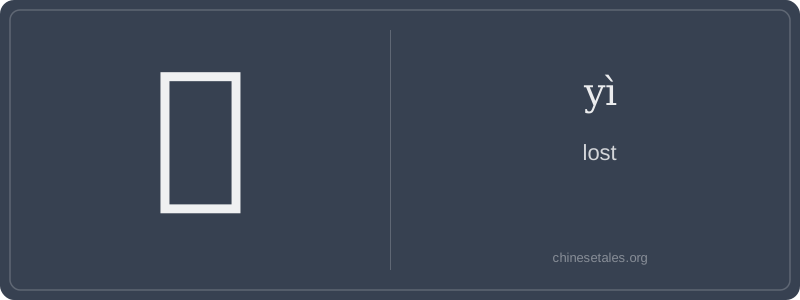
The earliest form of 佚 appears on Warring States bamboo slips as a variant of 逸 (yì, 'to flee, escape'), sharing its core component — 兔 (tù, 'rabbit') — originally drawn with long ears and a leaping posture. In 佚, the radical 亻 (rén, 'person') replaces the 辶 ('walk') radical, suggesting a *person* who has fled so completely they vanish from sight and record. The right side evolved from 兔 to the simplified 亦 (yì), which itself began as a pictograph of a person with outstretched arms — symbolizing 'also' or 'in addition', but here repurposed phonetically and visually to echo the idea of 'disappearing beyond reach'.
By the Han dynasty, 佚 was used in texts like the *Shuōwén Jiězì* to describe writings 'lost to transmission' — manuscripts no longer copied, their authors forgotten. Unlike 逸 (which retains motion and agency), 佚 emphasizes the *result*: irretrievable absence. The *Zuo Zhuan* even uses it to describe loyal ministers whose deeds were omitted from official histories — making 佚 a quiet protest against erasure. Its shape whispers: one person + one vanished rabbit = a life swallowed by time.
At first glance, 佚 (yì) means 'lost' — but not in the everyday sense of misplacing your keys. It’s a literary, almost poetic 'lost': vanished without trace, erased from records, or abandoned by time. Think ancient texts that disappeared for centuries, or a scholar whose name faded from history. This isn’t casual loss — it’s ontological disappearance, carrying quiet gravity and a whiff of melancholy reverence for what *should* have endured.
Grammatically, 佚 is almost never used alone in modern speech; it lives in compounds or classical-style phrases. You won’t say 'I lost my phone' with 佚 — that’s 找不到了 (zhǎo bù dào le). Instead, 佚 appears in formal writing: 佚名 (yì míng, 'anonymous'), 佚文 (yì wén, 'lost/unrecovered text'), or passive constructions like 'the original manuscript is 佚' (原稿已佚 — yuán gǎo yǐ yì). Note the crucial particle 已 (yǐ, 'already') — 佚 almost always partners with it to signal irreversible, historical loss.
Learners often mistakenly use 佚 where they mean 'missing' or 'absent' (e.g., for a person who skipped class — that’s 缺席, quē xí). Worse, some confuse it with 易 (yì, 'easy') due to identical pronunciation — a slip that turns 'the document is lost' into 'the document is easy'! Remember: 佚 is archival, solemn, and rare — like finding a Tang-dynasty poem in a Dunhuang cave scroll. Its rarity makes it precious, not practical.