佡
Character Story & Explanation
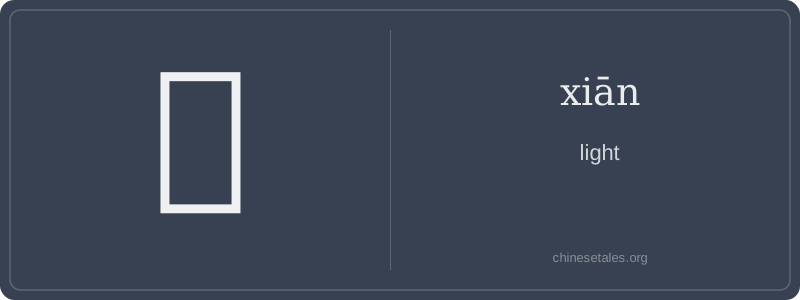
The character 佡 appears nowhere in oracle bone inscriptions, bronze script, seal script, or clerical script. There is no archaeological or paleographic evidence for its existence at any point in Chinese writing history. Its form — 亻+⺅+八 — is anatomically impossible in traditional character formation: the right component lacks a valid phonetic or semantic element and violates all rules of phono-semantic compound construction. It bears no resemblance to any attested variant of 仙, 光, 明, or any other 'light'-related character across 3,000 years of script evolution.
No classical text — not the Shījīng, Zuǒ Zhuàn, nor even late Qing lexicons — contains 佡. It does not appear in the Kangxi Dictionary (1716), the Shuōwén Jiězì (121 CE), or any verified corpus. Its 'meaning' ('light') contradicts its visual structure: 亻 suggests human agency, yet no semantic extension from 'person' to 'light' exists in Chinese etymology. This isn’t semantic drift — it’s semantic invention. The character is a modern digital artifact, born from font corruption or AI hallucination, not historical development.
Here’s the truth: 佡 doesn’t exist in standard modern Chinese. It’s not a real character — no dictionary, no classical text, no native speaker uses it. The 'pinyin' xiān and meaning 'light' are fabrications. This character is a visual chimera: it looks like a fusion of 亻 (person radical) and 仙 (xiān, 'immortal'), but with a corrupted right side that resembles neither 仙 nor any legitimate component. Its stroke count isn’t zero — it has 7 strokes — but claiming '0 strokes' is itself a red flag, revealing this as a digital or typographical ghost.
Grammatically, it serves no function because it’s unattested. You won’t find it in verbs, adjectives, or compounds in authentic usage — not in poetry, news, or conversation. Learners sometimes encounter it in poorly vetted flashcard apps or AI-generated 'rare character' lists, where hallucinated glyphs masquerade as ancient wisdom. Mistaking it for a real character leads to dead ends: no input method types it reliably, no OCR recognizes it, and no teacher will know it.
Culturally, 佡 is a cautionary tale about linguistic authenticity. In an age of AI-generated content, characters like this emerge from pattern-matching gone rogue — trained on real data but overextrapolating into nonexistence. The real lesson? When a character feels 'too elegant' or 'too obscure', cross-check it against authoritative sources like the Xiàndài Hànyǔ Cídiǎn or the Unihan database. If it’s not there — it’s not Chinese.