泳
Character Story & Explanation
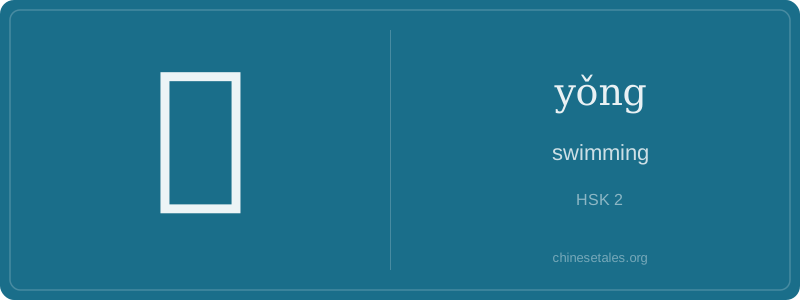
The earliest known form of 泳 appears in bronze inscriptions from the late Shang and early Zhou dynasties — not as a pictograph of a person swimming, but as a stylized combination: 氵 (three dots representing flowing water) on the left, and 央 (yāng) on the right, which originally depicted a person with arms outstretched and head tilted — a dynamic posture echoing mid-stroke movement. Over centuries, 央 simplified from a full figure into its modern box-and-cross shape, while the water radical remained consistently three dots (never four!). By the Han dynasty clerical script, the character had stabilized into its current eight-stroke form — elegant, balanced, and unmistakably aquatic.
This visual logic — water + 'central, active human presence' — reflects how ancient Chinese conceptualized swimming not as mere survival, but as *harmonious mastery* over water’s force. Classical texts rarely mention 泳 alone; instead, it appears in poetic compounds like 泳思 (yǒng sī — 'to meditate while swimming', a Daoist-inspired image of fluid contemplation). The character’s enduring structure — precisely eight strokes — subtly echoes the rhythmic, cyclical motion of freestyle: one stroke, two kicks, breath, repeat — a silent metronome in ink.
Think of 泳 (yǒng) as the Chinese equivalent of the English verb 'to swim' — but with a twist: it’s not just physical motion, it’s an *intentional, skilled act*, like 'to bicycle' or 'to ski'. In English, we say 'I swim', but in Chinese, 泳 almost never stands alone as a verb. Instead, it appears in compound verbs (游泳 yóu yǒng), nouns (泳衣 yǒng yī — 'swimwear'), or formal contexts (泳道 yǒng dào — 'swimming lane'). You’ll rarely hear a native speaker say '我泳' — that would sound as odd as saying 'I bicycle' instead of 'I ride a bike'.
Grammatically, 泳 is nearly always paired with 游 (yóu) to form 游泳 — a classic 'synonym compound' where both characters mean 'to move through water', reinforcing each other. It functions as a noun ('swimming') or a verbal noun ('go swimming'), and when used as a verb, it takes aspect particles like 了 (le): 我们游完了泳 (Wǒmen yóu wán le yǒng — 'We’ve finished swimming'). Learners often mistakenly try to use 泳 as a standalone verb — a red flag that instantly marks you as a textbook beginner.
Culturally, swimming carries connotations of discipline and health in modern China — especially since Mao Zedong famously swam the Yangtze River in 1966, turning it into a symbol of resilience and revolutionary vigor. Today, public pools are packed in summer, and 'learning to swim' (学游泳 xué yóu yǒng) is considered essential childhood training — much like learning to ride a bike in North America. A common mistake? Confusing 泳 with 永 (yǒng, 'eternal') — their similar pronunciation and stroke count (8 vs. 5) trip up beginners constantly.