玩
Character Story & Explanation
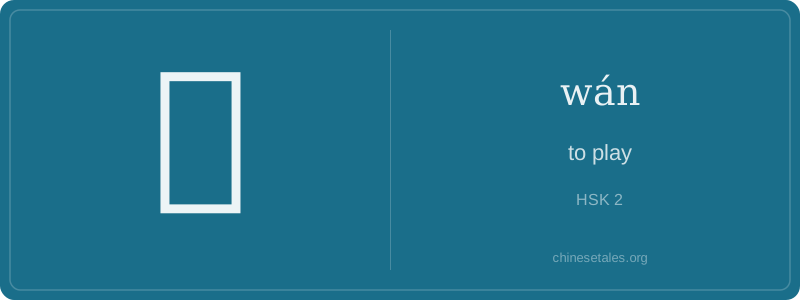
The earliest form of 玩 appears in bronze inscriptions around 1000 BCE: it combined 玉 (yù, ‘jade’) — written as a simplified ‘王’ radical (three horizontal strokes + a dot or vertical stroke, representing jade pieces strung together) — with 元 (yuán, ‘head’ or ‘origin’), later evolving into 反 (fǎn, ‘to turn’ or ‘reverse’), then simplified to 幺 (yāo, ‘tiny thread’) in modern script. The ‘王’ radical wasn’t about kingship here — it was a phonetic-semantic hint: jade objects were precious, delicate things one *handled*, *turned over*, *examined playfully* in hand. Over centuries, the right side streamlined from 元+攵 (‘action’) to 幺+丿+㇏, yielding today’s clean 8-stroke form.
This tactile origin explains why 玩 always implies active, hands-on engagement — not passive watching. In the Shuō Wén Jiě Zì (121 CE), it’s defined as ‘to handle and examine with care’, reflecting scholarly play with artifacts or texts. By the Tang dynasty, poets like Li Bai used 玩月 (wán yuè, ‘play with the moon’) — not literally grabbing it, but lingering, savoring, letting moonlight dance across wine cups. That poetic sensibility lives on: when Chinese say 玩得开心 (wán de kāi xīn), they mean ‘enjoyed the *process* of doing something’, not just the outcome.
Think of 玩 (wán) as Chinese’s joyful ‘play button’ — not just childlike fun, but the cultural permission slip to experiment, relax, and engage without rigid purpose. Unlike English ‘play’, which often implies games or performance, 玩 carries a subtle nuance of lightness, informality, and even gentle irreverence: you don’t ‘play’ chess in formal competition — you 玩 chess with friends over tea. It’s rarely used for serious, rule-bound activities (those lean toward 比赛 or 进行), but shines in casual, self-directed action.
Grammatically, 玩 is a verb that loves objects — ‘play + [thing]’: 玩手机 (wán shǒu jī, ‘play with/scroll on phone’), 玩游戏 (wán yóu xì, ‘play games’). Crucially, it *cannot* stand alone like ‘play’ in English: you’d never say ‘Let’s play!’ as ‘我们玩!’ — that sounds incomplete or childish; instead, you specify *what*: ‘我们玩飞盘吧!’ (Let’s play frisbee!). Learners often mistakenly omit the object or overuse it for sports (e.g., *‘玩篮球’ instead of ‘打篮球’), triggering a tiny linguistic eyebrow raise.
Culturally, 玩 has evolved from classical connotations of ‘to handle, toy with’ (even mildly dismissive) into today’s warm, everyday verb — yet traces remain: 玩火 (wán huǒ, ‘play with fire’) still warns of reckless experimentation, and 玩世不恭 (wán shì bù gōng) means ‘cynically flippant’. So while 玩 feels breezy, it’s got historical gravitas — like your favorite indie band that once wrote protest songs.