病
Character Story & Explanation
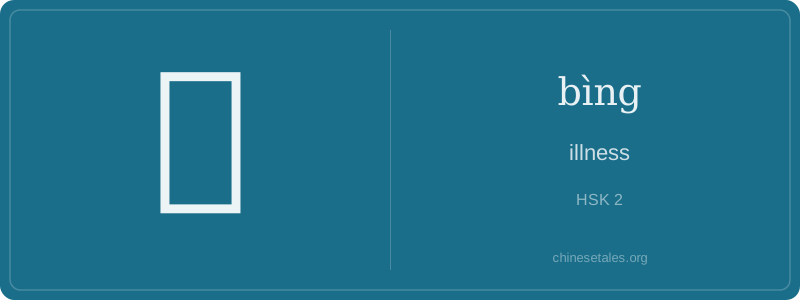
The earliest form of 病 appears in bronze inscriptions as two clear elements: the radical 疒 — a stylized figure lying on a mat, head propped up, spine curved — plus a phonetic component ‘丙’ (bǐng), which gave the sound. Over time, the ‘person-on-mat’ simplified into the left-side squiggle we now call 疒, while the right side evolved from 丙 (an ancient celestial stem) into today’s ‘丙’-like shape — now purely conventional, no longer pronounced bǐng but bìng. Every stroke tells a story: the dot above? A feverish forehead. The bent horizontal? A tired back. The final hook? A sigh.
By the Han dynasty, 病 had solidified as the go-to term for physical and mental affliction — Confucius himself lamented in the Analects: ‘子疾病,子路使門人為臣’ (When Master Kong fell gravely ill, Zilu ordered disciples to serve as ministers — revealing how illness disrupted ritual order). Its visual logic endured: the character doesn’t just name disease — it *re-enacts* the posture of suffering. Even today, when a Chinese doctor writes 病 on a chart, they’re invoking millennia of embodied understanding — not just diagnosis, but dignity in distress.
At its heart, 病 (bìng) isn’t just ‘illness’ — it’s the Chinese language’s visceral, embodied concept of *being unwell*. The radical 疒 (nè) — literally ‘sickness frame’ — is a visual whisper: a person lying down, head tilted, body weakened. That’s not abstract medical jargon; it’s ancient empathy carved in ink. In modern usage, 病 can be a noun (a cold), an adjective (feeling sick), or even a verb in literary contexts (‘to fall ill’), though learners usually meet it as a noun or in compound verbs like 生病 (shēng bìng, ‘to get sick’). You’ll hear it in daily life: ‘我生病了’ (wǒ shēng bìng le) — not ‘I have illness,’ but ‘I’ve fallen into sickness,’ with that perfect grammatical softness.
Grammatically, 病 rarely stands alone in speech — you almost never say *just* ‘病’ to mean ‘I’m sick.’ Instead, it pairs: 生病 (get sick), 有病 (have an illness — or colloquially, ‘you’re crazy!’), or 病人 (bìng rén, ‘sick person’). A classic learner trap? Using 病 as a standalone adjective like English ‘sick’ — saying *‘我很病’* (wǒ hěn bìng) sounds bizarre and unnatural. Native speakers say 我不舒服 (wǒ bù shū fu) or 我感冒了 (wǒ gǎn mào le).
Culturally, 病 carries subtle weight: it implies vulnerability, disruption, and care — think of the phrase 病从口入 (bìng cóng kǒu rù, ‘illness enters through the mouth’), a centuries-old hygiene proverb still scrawled on clinic walls. And yes, in slang, 有病 can mean ‘absurd’ or ‘off your rocker’ — but only among friends, never in formal or medical settings. This duality — clinical seriousness and cheeky exaggeration — is pure Chinese linguistic texture.