睛
Character Story & Explanation
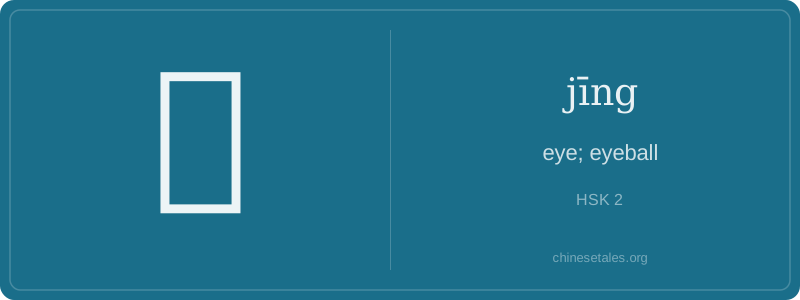
The earliest form of 睛 appears in seal script (c. 3rd century BCE), where it clearly shows the eye radical 目 on the left — a stylized rectangle with horizontal strokes inside, representing eyelids and iris — fused with 青 on the right. 青 originally depicted emerging plants under heaven (生 + 丹), symbolizing freshness and vitality; scribes borrowed its shape and sound to indicate ‘clarity’ and ‘liveliness’ of vision. Over centuries, the 目 radical simplified from a detailed eye-box to today’s 5-stroke form, while 青 lost its plant roots, becoming the clean, angular structure we write now — yet the marriage of ‘eye’ + ‘vital clarity’ remained intact.
In the Classic of Poetry (Shījīng), ‘bright eyes’ (炯然之睛) described noble vigilance; by the Tang dynasty, poets like Du Fu used 睛 metaphorically — ‘his gaze pierces clouds’ — turning the eyeball into a symbol of penetrating insight. Even today, when Chinese say 睛光 (jīng guāng, ‘eyeball-light’), they’re evoking that ancient link: the eye isn’t passive — it actively illuminates truth. The character’s very shape — 目 staring directly, 青 rising like focused energy — makes its meaning unforgettable once you see it.
Think of 睛 (jīng) as the 'precision lens' of the eye — not just any eye, but the eyeball itself: the shiny, central, light-capturing organ. It’s never used alone in modern speech (you’d never say *‘My jīng hurts’*); instead, it only appears in compound words like 眼睛 (yǎn jīng, ‘eye’) or 睛明 (jīng míng, ‘keen-eyed’). Its radical 目 (mù, ‘eye’) anchors it visually and semantically — this is literally an ‘eye-character’. The right side, 青 (qīng), isn’t about color here; it’s a phonetic clue (jīng sounds close to qīng) and subtly reinforces clarity — think of ‘qing’ as in ‘clear sky’, hinting at sharp vision.
Grammatically, 睛 is strictly a bound morpheme: it refuses to stand solo. Learners often mistakenly try to use it like English ‘eye’ — e.g., *‘Wǒ kànjiàn tā de jīng’* — but that’s ungrammatical. Correct usage requires pairing: 眼睛 (yǎn jīng) for the physical organ, or in literary/medical contexts like 视力 (shì lì, ‘vision’) + 睛 = 视力好 (not *jīng hǎo*). You’ll see it in health phrases (护眼护睛, hù yǎn hù jīng — ‘protect eyes and eyeballs’), reinforcing its role as the functional core of sight.
Culturally, 睛 carries quiet weight: in classical texts, ‘bright eyes’ (目光炯炯, mù guāng jiǒng jiǒng) signaled wisdom or moral clarity — the eyes weren’t just windows, but mirrors of the soul’s focus. A common error? Confusing it with 晴 (qíng, ‘sunny’) — same sound, same 青 component, but no eye radical! That mix-up swaps vision for weather — a poetic blunder, but a practical one to avoid.