笑
Character Story & Explanation
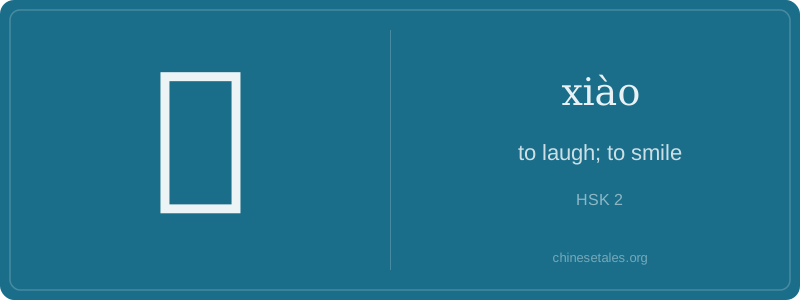
The earliest form of 笑 appears in bronze inscriptions as a stylized face with exaggerated, upward-curving mouth lines and two dots representing closed, crinkled eyes — no radical yet, just pure pictograph magic. Over centuries, the top evolved into ⺮ (bamboo), likely because bamboo leaves bend upward like a smiling mouth, and because bamboo was associated with lightness and resilience — qualities of laughter. The lower part solidified into 夭, which originally depicted a person dancing with arms raised (a joyful gesture), later simplified to the modern ‘夭’ component with its distinctive slanted stroke.
This visual evolution mirrors its semantic journey: from a concrete image of facial expression → to a symbol of emotional release and social grace. Confucius himself praised 笑 in the *Analects* (10.8), noting how the gentleman’s laughter is ‘not loud, not coarse, but always appropriate’ (不笑不语). Even today, the character’s balanced structure — bamboo above, dancing figure below — quietly embodies the Chinese ideal: inner ease (bamboo’s flexibility) expressed through graceful, grounded presence (the ‘dancing’ 夭).
At its heart, 笑 isn’t just ‘to laugh’ — it’s the sound and shape of human warmth made visible. Unlike English verbs that focus on action (‘laugh’, ‘smile’), 笑 carries a gentle, often quiet joy: think soft chuckles, knowing grins, or the crinkling of eyes in genuine delight. It’s rarely explosive — you wouldn’t use it for belly laughs (that’s 哈哈大笑); instead, it’s the polite smile at a shopkeeper, the shy grin of a child receiving praise, or the warm amusement in a friend’s voice.
Grammatically, 笑 is wonderfully flexible: it works as both verb (她笑了 — tā xiào le — ‘She smiled’) and noun (一个微笑 — yí gè wēixiào — ‘a smile’). Note the crucial particle 了 — learners often omit it when describing completed smiling, but without it, the sentence feels oddly suspended, like saying ‘she smile’ instead of ‘she smiled’. Also, 笑 never takes the aspect particle 着 (*xiào zhe*) for ongoing action — we say 微笑着 (wēixiào zhe) for ‘smiling’, not 笑着, because 笑 itself is too brief and punctual to sustain.
Culturally, 笑 is deeply tied to harmony and face-saving. In Chinese interactions, smiling can soften disagreement, mask embarrassment, or show respect — even when you’re not feeling joyful. Western learners sometimes misread a polite 笑 as insincerity; in fact, it’s often *more* sincere than a forced grin in English contexts. And beware: using 笑 sarcastically (e.g., 你真会笑 — nǐ zhēn huì xiào — ‘You’re *really* good at laughing!’) implies mockery — a subtle but potent tone shift that trips up many beginners.