篮
Character Story & Explanation
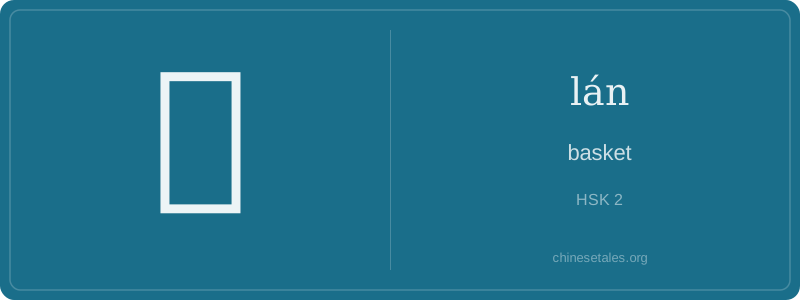
The earliest form of 篮 appears in seal script (c. 3rd century BCE), where it clearly shows ⺮ (bamboo) on top — two parallel strokes representing split bamboo strips — and 监 (jiān) below, originally a pictograph of an eye looking into a basin of water, later repurposed for its sound. Over centuries, 监 simplified into 皿 (a shallow dish or container) plus 丶 (a dot for emphasis), evolving into today’s 16-stroke structure: ⺮ + 奸 (a phonetic component derived from 监) — wait, no! Actually, the lower part is + 皿: the 'jian' sound element was gradually stylized into what now looks like 奸 without the female radical, then fused with the base 皿 (dish). Visually, it’s bamboo strips woven over a shallow receptacle — a perfect blueprint for a basket.
This character first appeared in texts like the Shuōwén Jiězì (121 CE), defined as 'a vessel made of bamboo for holding things'. By the Tang dynasty, 篮 had expanded beyond utility: poets used 花篮 (huā lán, flower basket) in ceremonial contexts, and by the Ming era, 篮子 entered everyday vernacular as a warm, tactile word — still carrying that ancient bamboo scent of craftsmanship and containment. Its visual logic remains intact: if it’s woven, portable, and holds stuff? Chances are, it’s got ⺮ + a container base — and that’s 篮.
Think of 篮 (lán) as Chinese basketball’s secret origin story — not the sport, but the *container* that made it possible. At its core, 篮 means 'basket': a woven vessel for carrying, holding, or collecting — just like your wicker fruit basket at home. But unlike English, where 'basket' is mostly noun-only, 篮 in Chinese often appears in compound nouns and rarely stands alone in speech; you’ll almost never say just '篮!' — it’s always 篮球 (lán qiú, basketball), 菜篮 (cài lán, vegetable basket), or 篮子 (lán zi, basket — note the mandatory 'zi' suffix!).
Grammatically, 篮 is strictly a noun root — no verb forms, no adjectival uses. Learners sometimes mistakenly try to use it like 'to basket' (e.g., *wǒ lán le shū*), but that’s ungrammatical; instead, use 放进篮子 (fàng jìn lán zi, 'put into the basket'). Also, while 篮 looks complex, its radical ⺮ (bamboo) is your anchor: over 95% of characters with this radical relate to bamboo objects — baskets, brushes, flutes, even chopsticks.
Culturally, baskets symbolize care and domestic rhythm: the 菜篮 (cài lán) evokes grandmas bustling through wet markets, and 篮球 (lán qiú) reflects how Western imports were linguistically 'sinicized' — literally 'basket ball', preserving the container’s centrality. A classic mistake? Confusing 篮 with 蓝 (lán, 'blue'), which shares pronunciation and tone but zero meaning — they’re homophone landmines!