肉
Character Story & Explanation
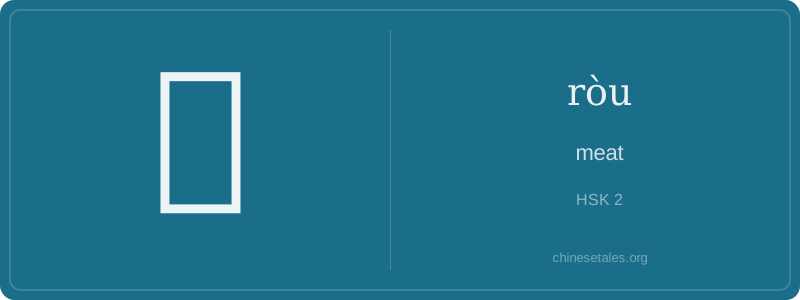
The earliest form of 肉 appears on Shang dynasty oracle bones as a stylized drawing of a slab of hanging meat — two parallel vertical lines representing the sides of the cut, with horizontal strokes between them showing layers or striations of muscle and fat. Over centuries, the shape simplified: the top became a flattened ‘⺼’ (the ‘flesh’ radical), while the bottom evolved into a compact, closed shape — the modern 肉. Interestingly, when used as a left-side radical (as in 肝, 肺, 肌), it transforms into ⺼, losing its dot and becoming narrower — a visual clue that it’s now functioning as a semantic marker, not a standalone word.
This character didn’t just mean ‘edible animal tissue’ — in ancient texts like the *Shijing* (Book of Odes), 肉 evoked sacrifice, ritual, and kinship: offering meat to ancestors was sacred duty. Its shape, echoing suspended flesh, reinforced ideas of substance, nourishment, and mortality. Even today, the visual echo remains — look closely: the four interior strokes resemble tender muscle fibers, and the enclosing frame feels like a butcher’s wrap. No wonder it’s the radical for dozens of body-related characters: it’s literally the building block of physical existence.
At its core, 肉 (ròu) means 'meat' — but not just any meat: it’s the warm, fleshy, edible kind from animals (and sometimes metaphorically from humans or plants). Unlike English ‘meat’, which can be abstract (e.g., ‘the meat of the argument’), 肉 stays stubbornly physical and visceral. It’s never used for plant-based ‘meat’ unless explicitly qualified (like ‘soy meat’ — 豆腐肉), and you’d never say 肉 for ‘flesh’ in a medical or poetic sense without context — that’s where 肌肉 (jīròu, muscle) or 皮肉 (píròu, skin and flesh) step in.
Grammatically, 肉 is a noun that loves measure words: 一块肉 (yí kuài ròu, ‘a piece of meat’) is far more natural than just 肉 alone. It rarely appears bare — even in menus, you’ll see 牛肉 (niúròu, beef), 猪肉 (zhūròu, pork), or 肉丝 (ròu sī, shredded meat). Crucially, it’s *not* used for fish or seafood — those get their own characters (鱼 yú, 虾 xiā). Learners often mistakenly say *ròu* for ‘fish’, leading to hilarious misunderstandings like ‘I ate meat’ instead of ‘I ate fish’.
Culturally, 肉 carries weight: historically scarce and expensive, it signals prosperity (hence phrases like 大鱼大肉 — dà yú dà ròu, ‘rich food’). But there’s also a charming quirk: in slang, 肉 can mean ‘slow’ or ‘laggy’ (from the phrase 肉得很 — ròu de hěn, literally ‘very meat-like’, implying sluggishness — as if your brain has turned into slow-cooking brisket!). This playful extension shows how deeply embodied this character is in daily speech.