药
Character Story & Explanation
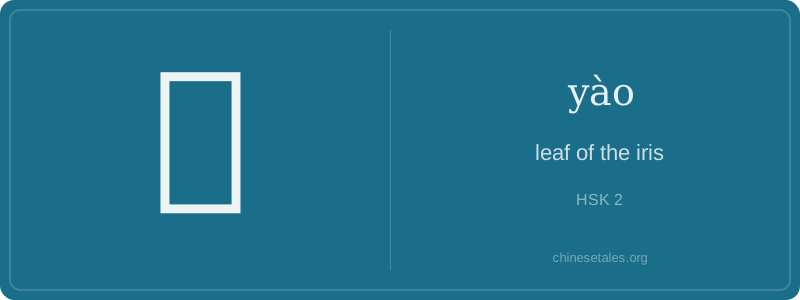
The earliest form of 药 appears in seal script as a combination of 艹 (grass) above and 樂 (lè, 'joy/music') below — not because medicine is fun, but because 樂 here was a phonetic loan, approximating the ancient pronunciation *ŋrak. Over centuries, 樂 simplified dramatically: its upper part (絲 sī, 'silk') vanished, and its lower 口 kǒu ('mouth') morphed into 约 yuē ('to bind') — giving us today’s modern structure: 艹 + 约. Visually, it’s nine clean strokes: three grass-head dashes, then the compact, looping 约 — like a little plant bound up in a medicinal bundle.
This evolution mirrors meaning shift: from 'iris leaf' (in the Shijing, or Book of Songs, where iris rhizomes were used ritually) to 'herbal remedy', then to 'all medicine'. By the Han dynasty, 药 appeared in medical texts like the Huangdi Neijing as the standard term for therapeutic substances. The visual link remains potent: even now, seeing 药 instantly evokes green herbs, apothecary drawers, and the quiet authority of healing — all rooted in that ancient grass radical.
Let’s start with a surprise: despite its modern meaning 'medicine', 药 originally meant 'leaf of the iris' — a delicate, fragrant plant prized in ancient China for both beauty and healing. That botanical root is right there in the radical 艹 (grass/plant), anchoring the character firmly in the natural world. Over time, 'iris leaf' became shorthand for any plant used therapeutically — then broadened to all medicines, herbal or synthetic. Today, 药 feels warm but serious: it’s the word on pharmacy signs, doctor’s prescriptions, and your grandma’s steaming bowl of bitter decoction.
Grammatically, 药 is a noun (always countable — say 一粒药 yī lì yào, 'one pill'), never a verb. Learners sometimes mistakenly use it like 'to medicate' — nope! You don’t 'yào' someone; you '吃药 chī yào' (eat medicine) or '吃药了 chī yào le' (has taken medicine). It also appears in fixed expressions like '没药了 méi yào le' (out of medicine) — note the measure word 粒 lì for pills, or 剂 jì for doses, never 个 gè.
Culturally, 药 carries quiet reverence: it’s tied to Traditional Chinese Medicine’s holistic philosophy, where 'medicine' isn’t just chemical intervention but balance-restoring nature. A common mistake? Confusing 药 with 易 (yì, 'easy') — they sound similar but share zero meaning or shape. Also, be careful with tone: yào (4th tone) ≠ yāo (1st tone, 'to demand'). Say it sharply — like you’re handing over a vital prescription!