踢
Character Story & Explanation
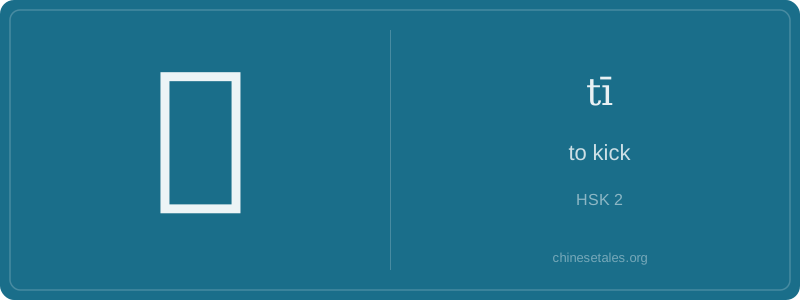
The earliest form of 踢 appears in seal script (c. 3rd century BCE), where the left side clearly depicts a stylized foot with three toes and an extended leg — unmistakably 足. On the right, 易 was already recognizable as a simplified depiction of a vessel being poured from one container to another, symbolizing 'change' or 'exchange'. Over centuries, the foot radical condensed into today’s 足 (7 strokes), while 易 lost its pictorial clarity, evolving from a flowing liquid shape into its modern angular form — yet retaining its phonetic role. By the Tang dynasty, the character stabilized into its current 15-stroke structure, with the foot firmly planted on the left and the sound marker anchored on the right.
This character didn’t appear in the earliest oracle bones — kicking as a lexical concept gained prominence alongside organized sports and military training. Classical texts like the *Zuo Zhuan* mention foot combat (‘足击’), but 踢 itself first surfaces reliably in Song dynasty vernacular stories, reflecting rising interest in everyday physicality. Its visual logic is beautifully literal: the foot radical doesn’t just hint at the body part — it *demands* it. You cannot ‘踢’ without involving the foot; even metaphorical uses (like ‘kicking off’ a project) retain that sense of initiating forceful, grounded action — no hands, no hesitation, just sole-to-target impact.
At its heart, 踢 (tī) is all about forceful, directed motion with the foot — not just any foot movement, but a sharp, intentional kick: think soccer penalty kicks, martial arts sidekicks, or even playfully kicking a pebble. The character’s radical 足 (zú, 'foot') anchors it firmly in physical action, while the right-hand component 易 (yì, 'easy' or 'change') is purely phonetic here — it gives the sound tī (a historical sound shift from *lək > tī), not meaning. So visually, it’s 'foot + sound', not 'foot + easy' — a classic case where learners mistakenly read meaning into phonetics.
Grammatically, 踢 is a transitive verb requiring an object: you kick *something* — a ball, a door, even someone’s shin (though context matters!). It rarely stands alone; you’ll almost always see it as part of a compound (踢球, 踢腿) or with aspect particles (踢了, 正在踢). A common mistake? Using it like English ‘kick’ in idioms: you don’t ‘kick a habit’ — that’s 戒 (jiè). Also, never say ‘踢一下’ to mean ‘try’ — that’s 尝试 (chángshì). Precision matters!
Culturally, 踢 carries playful, athletic, and sometimes confrontational energy. In traditional opera, 踢枪 (tī qiāng, 'kicking spears') is a dazzling acrobatic feat — performers catch flying spears mid-air with their feet. But in daily speech, 踢 can signal dismissal (踢出局, 'kick out of the group') or even bureaucratic avoidance (踢皮球, 'kick the ball' = passing responsibility). Learners often overuse it for gentle foot contact — use 碰 (pèng, 'touch lightly') or 撞 (zhuàng, 'bump') instead.