送
Character Story & Explanation
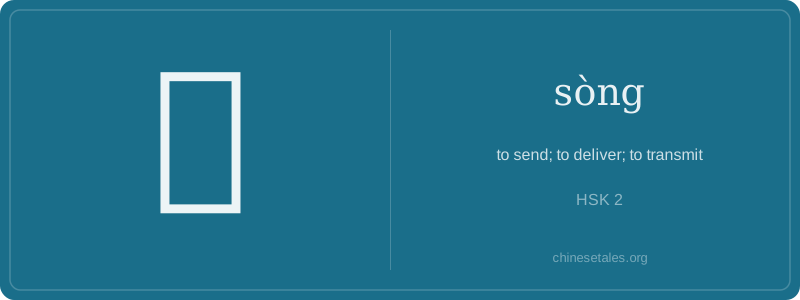
The earliest form of 送 appears in bronze inscriptions as a combination of 辵 (an early form of 辶, depicting a foot walking) and 關 (guān, later simplified to 丷 + 王), which originally represented a ritual token or sealed document. Imagine a ceremonial envoy stepping forward (the walking radical) holding a formal dispatch — not just moving, but *entrusting*. Over centuries, the top evolved from a complex seal into the clean 丷 (like two downward strokes) above a simplified 王 (which here doesn’t mean 'king', but echoes the shape of an ancient tally stick), while the leftward stroke became the standardized 辶 radical — always anchoring the character in motion.
This visual logic held firm: from Zhou dynasty envoys delivering royal edicts on foot, to Tang poets writing '送元二使安西' ('Seeing Off Yuan Er to the Western Regions'), where 送 conveys both physical departure and emotional farewell. Even today, the character retains that dual weight — it’s never just logistical. In classical texts, 送 often appears in rites of passage: sending off scholars to exams, brides to new families, or spirits in funerary rites. The walking radical isn’t incidental; it’s the heartbeat of the character — every 送 implies a journey begun, witnessed, and imbued with meaning.
At its heart, 送 (sòng) is about *movement with intention* — not just tossing something away, but thoughtfully placing it into someone else’s hands or path. It carries warmth and responsibility: you’re not merely dispatching an object, you’re bridging space to connect people. That’s why it’s used for sending gifts, letters, even people (e.g., 送朋友去机场 — 'send a friend to the airport'), and even abstract things like greetings (送祝福). Notice how it always implies a *sender*, a *recipient*, and a *direction* — which is why the ‘walking’ radical 辶 (chuò) isn’t decorative; it’s essential grammar made visible.
Grammatically, 送 is a transitive verb that loves two objects: 'send [thing] [to person]'. So we say 他送我一本书 (tā sòng wǒ yī běn shū — 'He sent me a book'), where 我 is the indirect object and 一本书 the direct object. Learners often mistakenly drop the recipient ('He sent a book') — but in Chinese, that sounds incomplete unless context makes it obvious. Also, 送 never means 'to go' by itself — unlike 去 or 走 — so 'I send to school' is wrong; it’s 'I send my child to school' (我送孩子去学校).
Culturally, 送 is deeply tied to face (miànzi) and reciprocity. Sending a gift isn’t neutral — it signals respect, apology, or celebration, and often expects acknowledgment or return. A common mistake? Using 送 for 'to mail' without specifying the medium — native speakers prefer 寄 (jì) for postal mail (寄信), reserving 送 for hand-delivery or personal conveyance. And remember: 送 is *not* for digital transmission (that’s 发 fā — 'send a WeChat message'); 送 feels tactile, human, and present.